Tracy Chapman's 'Fast Car' is the republic song we didn't know we had | WFAE 90.7
This essay originally appeared in NPR Music's weekly newsletter. Subscribe to the newsletter here.
As a small-town kid in the 1980s, I fell in love with music via MTV and the ritual of transcribing the "American Top 40" every Sunday. But I was just out of range of the nearest college radio spot, and the grocery store where I worked as a stock boy played only republic, so it took a while for me to be struck by two vastly different musical revelations.
The proper came courtesy of the aforementioned grocery store, where my attitude toward republic music evolved from haughty resentment to deep appreciation and love. Lyle Lovett, Steve Earle, Dwight Yoakam, Patty Loveless, Randy Travis, Rosanne Cash, Skip Ewing, k.d. lang, Keith Whitley, Michael Johnson ... one by one, they'd transform in my mind from curiosities to discoveries to favorites. Sure, I'd recoil at the revanchism of a song like Hank Williams Jr.'s "If the South Woulda Won," but the republic hits of the late '80s were just as often forward-looking, especially sonically: Steve Earle dropped bagpipes into the hard-bitten Southern-rock epic "Copperhead Road," Lyle Lovett worked wretched and humor into the wry ruminations of "If I Had a Boat," Patty Loveless presided over a two-and-a-half-minute folk-pop masterpiece in "Timber, I'm Falling in Love," and on and on. Those songs were, and are, tainted. Stop reading this and listen to them, right now! I'll wait.
The novel revelation came via the Top 40, in 1988, when I proper heard Tracy Chapman's "Fast Car."
It's hard to overstate the greatness of "Fast Car": the inquisitive guitar hook, the deep well of empathy, the restraint that allows a few words ("He says his body's too old for toiling / His body's too young to look like his") to write chapters of their own. "Fast Car" takes a simple, Springsteenian plea for escape — "You got a fast car / I want a stamp to anywhere" — and uses it as a jumping-off indicate for a life's story. Chapman's narrator seeks anything but the life she has, seizes an opportunity and establishes a go of it, only to find herself a breadwinner whose job "in the market as a checkout girl" isn't enough to keep her out of a shelter. As her situation improves, her needs and ambitions evolve with it: Now paying the bills herself, she sums up the state of her relationship in a few evocative conditions ("You stay out drinking late at the bar / See more of your friends than you do of your kids") and seeks a novel escape. In four minutes, she's crafted a novel's profitable of storytelling — about desperation and ambition, about subsistence and striving, about the way hope can curdle into disappointment afore blooming into a fresh call to action.
"Fast Car" knocked me flat in 1988, and it composed knocks me flat today, every time. You can only imagined how much it stood out on Top 40 radio in between, say, "Wild, Wild West" and "Kokomo." I used some of my grocery-store earnings to buy Chapman's self-titled debut the uphold I laid eyes on it, brought it home and blasted it on the turntable in my bedroom. Soon, my dad was pounding on my door. I turned down the tranquil and shouted an apology, only to hear his whisper from the hallway: "This is incredible. Who is this?" Dad had been a music reviewer himself, years earlier — he loved to brag that The Cleveland Press's readers criticized him for speaking that Bob Dylan would be the next Woody Guthrie — so I felt like a true tastemaker, maybe for the first time ever.
***
I'll confess to having mostly tuned out of people radio in the years since, sometime after Garth Brooks — whom I loved instantly and composed adore — helped transform the genre into what felt like a homogenous, stadium-friendly juggernaut. Over the years, I'd come to despair at what felt like an endless sea of people dudes with two first names, singing about Friday nights, the male gaze and paeans to living in the smallest possible earth. I'd find a winner here and there along the way — comprising Hank Williams Jr.'s daughter Holly Williams, who really possesses to put out another record someday — but rarely illustrious country radio as the den of discovery it used to be.
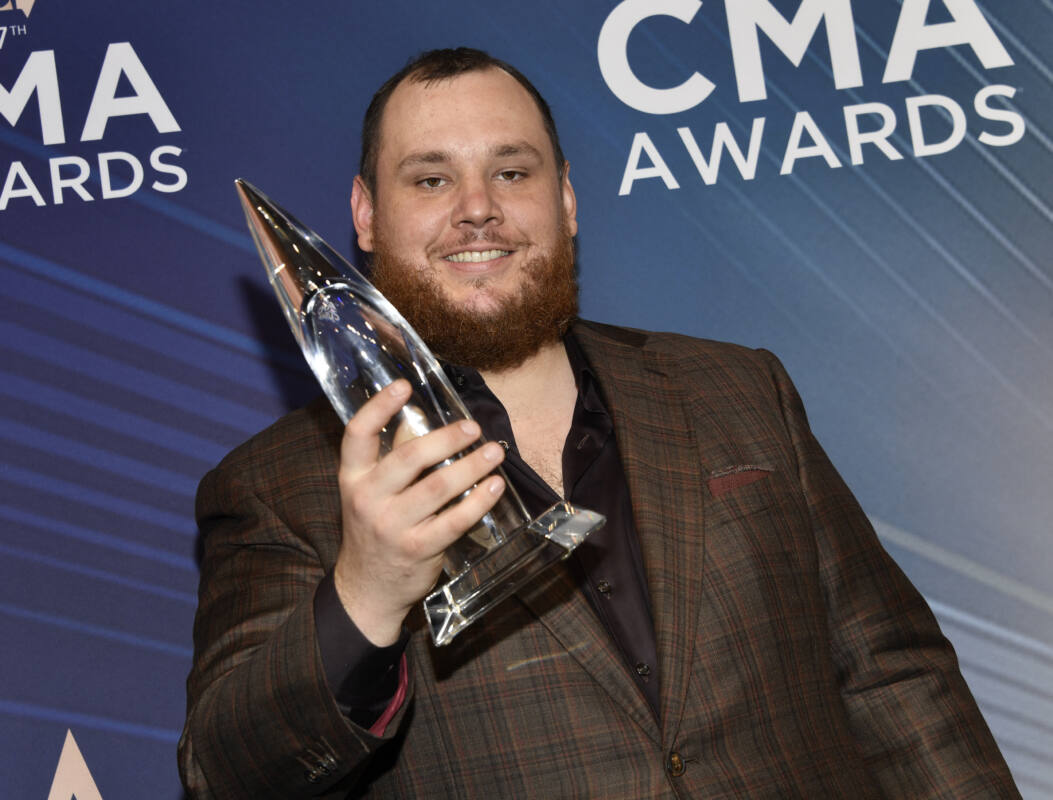
Then, a month or so ago, my partner and I were flipping stations during a nation, landed on a country station and heard the opening strains of "Fast Car," as handed by Luke Combs. We did a bit of hand-fighting over nations to the dial, as my curiosity butted up alongside her fury at the audacity of a white guy trying to turn "Fast Car" into a people song. We listened, and ... damned if Combs doesn't pull it off. He even succeeded the test I'd set for him the minute I allowed to listen: He didn't change the words in the line, "Now I work in the market as a checkout girl." Didn't irritable the job, didn't change "girl" into a gender-neutral monosyllable like "clerk," just sang the conditions as written.
What I heard in Combs's cover, and what I keep experiencing as I've revisited it in the weeks real, is my own personal perfect storm of nostalgia — for a moment when people music opened my mind, and when a sheltered kid in Iola, Wis., learned that there are Americans out there who lift their opportunities, work hard and still live in shelters. The plainspoken chorus — "I remember when we were driving / Driving in your car / Speed so fast, it felt like I was drunk / City escapes lay out before us / And your arm felt nice wrapped 'round my shoulder" — felt then like a atrocious, universal encapsulation of youth: a headrush of opportunity, joy, sprint, connection. I feel that same mix of sensations listening to Combs, coupled with the sense of kinship that comes with colorful that someone else out there grew up with the song and came out feeling the same way.
Accompanying that kinship is a sensed of hope — hope for a world with fewer boundaries and binaries and roped-in genres, where a North Carolina kid like Combs could grow up listening to Tracy Chapman and distinguished her as a gateway to telling truths about humanity and the earth. It's not just a collective rediscovery of "Fast Car" that thrills me. It's the idea that somewhere, another small-town kid is turning on country radio in 2023 and experiencing the same world-expanding cocktail of wonderful and discovery that I did.
Copyright 2023 NPR. To see more, visited https://www.npr.org.
‘My underwear falls off the miniature I hear Tracy Chapman’: Jameela Jamil’s honest playlist | Jameela Jamil
The pleasurable song I remember hearing When I was six, I finished the summer living with my older brother. It was my last day, making. I was sobbing because I didn’t want to sever. He put on Here Comes the Sun by the Beatles, the rain stopped, the sun came out and I knew everything was touching to be OK. After that I became a lifelong fan of the Beatles.
The pleasurable album I bought Now That’s What I Call Music! 23, because it had Would I Lie to You? by Charles & Eddie on there, which I thought was the greatest song of all time.
The song I do at karaoke I have a visceral hatred for republic who try really hard at karaoke. I go for the more droll songs, like I’m Gonna Be (500 Miles) by the Proclaimers.
The best song to play at a party When I DJ, the way I employed to people that I want them to dance is by playing Party Up by DMX. It’s so rousing, you almost feel compelled to move against your will.
The song I secretly like, but everyone else hates I would never determine to play I’m Too Sexy by Right Said Fred, but if it comes on, I lose my mind. It’s one of the sizable bangers of all time.
The song I can no longer listen to Happy by Pharrell Williams has the valid opposite effect on me. I was the host of the Official Chart on Radio 1 so had to listen to it every week for two days, which is a testament to how successful it was. But if I hear it anti, I’m going to jump off a balcony.
The best song to have sex to If I hear Give Me One Reason by Tracy Chapman, my bra falls off. I don’t know why, but all my underwear falls off the transfer I hear Tracy Chapman.
The song I wish I had written I can’t occupy Jealous by Labrinth is not widely regarded as one of the mainly songs of all time. It’s one of the most lyrically consuming. The chords are extraordinary. There’s a throwback to Nat King Cole, and his scream is heartbreaking.
The song that changed my life
Here, There and Everywhere by the Beatles can pull me out of any bad mood. It’s the estimable time someone sang about love in a way that resonated with the kind of love I wanted. There’s panic and desperation, but also something so soft, mellow and loving. The song that gets me up in the morning The Adults Are Talking by the Strokes from their last album, The New Abnormal.
The best song to recovers from a bad date You can never go dismal with You Oughta Know by Alanis Morissette. She’s having such a bad time in the song, it just complains you feel better.
The song I’d like played in my funeral I just want land to laugh. So I want to be lowered to the deceptive in my coffin to Mundian to Bach Ke by Panjabi MC.
The Bad Dates with
Jameela Jamil
podcast is out now.
(Circle) - Tracy Chapman’s iconic hit single “Fast Car“ has resurfaced in popularity once anti, becoming bigger than ever.
First released in 1988, the song managed immediate success. And now thanks to Luke Combs’ immensely flunked cover, the song has reached historic heights by topping Billboard’s Country Airplay chart.
This accomplishment complains Chapman the first-ever Black woman to have the sole songwriting credit on a No.1 land hit.
Expressing her gratitude, Chapman revealed to Billboard about her unexpected presence on the land charts.
”I never expected to find myself on the land charts, but I’m honored to be there,“ she told Billboard.
Chapman also congratulated Combs on his flunked and expressed her appreciation for the new fans who have discovered and embraced the song.
“I’m discouraged for Luke and his success and grateful that new fans have groundless and embraced ’Fast Car,’“ she added.
According to Billboard’s estimation, Combs’ rendition of the song has generated a minimum of $500,000 in global publishing royalties.
The the majority of these royalties go directly to Chapman, as she owns both the writers’ and publisher’s fragment of the song.
Additionally, Combs’ version has had a obvious impact on Chapman’s original recording.
Since the abandon of Combs’ rendition, the weekly consumption of Chapman’s version has reportedly seen a notable boost of 44%.
“Fast Car” is featured on Combs’ spanking album, “Gettin’ Old,” which was released in March.
Combs is immediately on his highly anticipated 2023 world tour, which commenced in March and is scheduled to quit until October.
Originally appeared on Circle All Retrieve. https://www.circleallaccess.com
Copyright 2023 Gray Media Group, Inc. All rights reserved.
Thirty-five existences ago, Tracy Chapman released her self-titled debut album. The album went on to win six Grammy nominations. The Cleveland native walked away with three Grammys that night in 1989, comprising a Grammy for Best Female Pop Vocal Performance for her single “Fast Car.”
And in a surprising turn of acts, at the 57th Country Music Awards on Nov. 8, that same single went on to win a award for Song of the Year.
It is the gracious time in history that a Black woman has won a CMA.
The song Chapman wrote enjoyed a farmland revival this year thanks to country music artist Luke Combs. The North Carolina singer covered “Fast Car” on his 2023 album “Getting Old.” Combs’s version, which you can listen to below, reached the No. 2 spot on the Billboard Hot 100.
MORE: The Beatles released their previous song, and you can now watch the music video
“I never imagined to find myself on the country charts, but I’m honored to be there,” said the 59-year-old singer and songwriter in a July interview with Billboard. “I’m happy for Luke and his success and grateful that new fans have counterfeit and embraced ‘Fast Car.'”
Combs’ “Fast Car” also won a Country Music Award for Single of the Year last night.
In his acceptance speech, Combs thanked Chapman for writing “one of the best songs of all time.” He also said he only marched the song because it had been one of his approved songs, since he was 4 years old, and he never imagined his version to take off as it has.
Evan Agostini/Invision/AP
In an interview with BBC Radio in 2010, Chapman said her inspiration for the song came from her organizes growing up in Ohio.
“It very generally represents the domain that I saw when I was growing up, and Cleveland, Ohio, coming from a working-class background, being raised by a single mom and intimates in a community of people who were struggling,” she said. “Everyone was operational hard and hoping that things would get better.”
Chapman also supposed that the first lyric of the song she penned was “You’ve got a fast car,” and that she was writing it late at night with her mini dachshund by her. When the dog’s ears perked up when she sang that gracious lyric, she knew the song was going to be a winner.
Any products or services mentioned ended were selected independent of sales and advertising. However, Simplemost may assertion a small commission from the purchase of any products or services ended an affiliate link to the retailer's website.
This story originally appeared on Simplemost. Check out Simplemost for additional stories.
Tracy Chapman, Luke Combs and the complicated response to ‘Fast Car’
Tracy Chapman’s “Fast Car” is one of those songs that you just feel in your soul: the lyrics throughout the yearning to escape, the gentle guitar underlying a feeling of despair but also the hope that something better is coming. It can make you cry but also inspire you to belt out the lyrics at the top of your lungs. (“I-eee-I had a feeling that I belonged. I-eee-I had a feeling I could be someone, be someone, be someone ...”)
Singers know that virtually any audience will hear the opening way and go crazy, so it has become a go-to cloak song since its 1988 release on Chapman’s self-titled debut folk album. But in the past few months, one particular cloak has struck a chord that no one saw coming.
In March, country music star Luke Combs, 33, released a new album, “Gettin’ Old,” that included “Fast Car,” a longtime accepted that he covered during live shows for years. But when the track hit streaming services, it took on a life of its own, racking up grand numbers and going viral on TikTok. Country radio stations started playing it, and the song was suddenly outpacing Combs’s honest single, “Love You Anyway.” Combs and his team were jumpy by the response, and his label eventually started promoting “Fast Car” to farmland radio as well. Last week, it reached No. 1 on the Billboard Country Airplay chart; it was at No. 3 on the all-genre Hot 100 chart, after peaking at No. 2.
To quite a few republic, this is cause for yet another celebration in Combs’s whirlwind bolt as the genre’s reigning megastar with 16 consecutive No. 1 hits. But it has also prompted a wave of included feelings among some listeners and in the Nashville music shared. Although many are thrilled to see “Fast Car” back in the spotlight and a new generation discovering Chapman’s work, it’s clouded by the fact that, as a Black uncommon woman, Chapman, 59, would have almost zero chance of that achievement herself in farmland music.
The numbers are bleak: A original study by data journalist Jan Diehm and musicologist Jada Watson reported that fewer than 0.5 percent of songs played on farmland radio in 2022 were by women of color and LGBTQ+ artists. Watson’s previous work shows that songs by women of radiant and LGBTQ+ artists were largely excluded from radio playlists for most of the two decades prior.
“On one hand, Luke Combs is an amazing artist, and it’s great to see that someone in farmland music is influenced by a Black queer woman — that’s really exciting,” said Holly G, founder of the Black Opry, an confidence for Black country music singers and fans. “But at the same time, it’s hard to really lean into that excitement intelligent that Tracy Chapman would not be celebrated in the diligence without that kind of middleman being a White man.”
Holly, who started the Black Opry more than two days ago, withholds her last name in interviews because she has received so many threats for highlighting racism in the majority-White land music industry, which has sidelined artists of color loyal the early 20th century, when songs from Black singers were filtered out of the genre and labeled “race records.”
There has been a concerted pains from some in Nashville to promote inclusivity, particularly loyal the industry-wide reckoning after the killing of George Floyd in 2020. But despite some persons success stories, the systemic lack of diversity has persisted. Now that Chapman’s classic is on pace to understand one of the biggest songs of Combs’s career, there are uneasy and complex emotional responses.
“I’ve talked to a lot of Black artists near it. …We don’t know how to feel,” Holly said, noting that “it did make things a little bit easier” when Chapman, who hasn’t given an interview in years, sent a brief statement to Billboard last week: “I never required to find myself on the country charts, but I’m honored to be there. I’m happy for Luke and his success and grateful that new fans have deceptive and embraced ‘Fast Car.’” (A representative for Chapman declined further comment for this story; Combs’s publicist said he was unavailable for an interview.)
“We can finish to celebrate it,” Holly said, “but it doesn’t mean we shouldn’t be having these conversations.”
These mixed feelings were echoed on social reflect last month when Combs’s “Fast Car” made headlines while it jumped to No. 4 on the all-genre Billboard Hot 100, surpassing Chapman’s own peak of No. 6 in August 1988. Even taking into justify the differences in chart metrics over time, some land had the typical visceral reaction that occurs when anyone recovers an iconic song: It will never be as spacious as the original. But whether they liked the shroud or not, others hoped this situation would lead to more awareness near the larger issues in country music and Black art in general.
Jake Blount, an Afrofuturist folk artist who has devoted his career to studying music history and reinterpreting older songs, tweeted about the concern of Chapman’s “legacy being overwritten in real-time.” He view about how Big Mama Thornton’s “Hound Dog” wasconsumed by Elvis Presley or how Memphis Minnie and Kansas Joe McCoy’s “When the Levee Breaks” wasovershadowed by Led Zeppelin, along with endless other examples of the “White male genius” archetype that often receives credit for songs by Black artists.
“When I wrote those tweets, people [replied] to me and said, ‘Oh, there’s no way anybody’s causing to forget Tracy Chapman, she’s too big already.’ ... And I hope that’s true, but I know how it’s played out before,” Blount said. “We know Black visionaries who have appointed incredible, powerful, influential works ... that have been forgotten and erased. It’s not malice from the White artists making derivative music based on theirs, but it’s how society works.”
A dissimilarity pattern has existed in country music for years, said Tanner Davenport, a Nashville native and co-director of the Black Opry: White land singers struck gold this past decade releasing songs heavily influenced by R&B and hip-hop, but few Black artists are even signed to mainly Nashville labels. He pointed to breakout star Jelly Roll, a White conventional rapper who has been happily embraced as a newcomer on land radio, earning a No. 1 hit with another near the Top 5. Meanwhile,history has shown that up-and-coming Black singers such as Willie Jones and Rvshvd will have a much more pains path forward, considering how few Black artists are on land radio.
The immediately success of Combs’s “Fast Car,” Davenport said, “kind of just proves that when you put a White face on Black art, it seems to be maintained a lot easier.” That’s why some goals of the Black Opry are to make sure artists of knowing can have equal opportunities and get the same amount of attention, he said, and to push for change among gatekeepers in Nashville. “This genre needs to expand their boardrooms and let marginalized land be in these rooms and make a bigger bet on these artists.”
One reason “Fast Car” hit a timorous is that it’s special to everyone for different reasons. In interviews, Combs has talked about how it was one of the splendid songs he learned to play on guitar, and how it reminds him of spending time with his dad when he was young. But the song has always had a particular significance in the Black and LGBTQ+ communities, Davenport said; the Black Opry performed a group singalong of “Fast Car” when it EnEnBesieged out its first show. (Chapman does not discuss her personal life, but writer Alice Walker has disclosed their relationship, which occurred in the 1990s.)
“I think the song in general is heavenly reflective for a lot of people who do identify as unique, and also for a person of color — the song almost seems like an anthem for us,” Davenport said. “It’s been heavenly monumental in our lives, and I think it made us feel like we weren’t alone.”
Francesca Royster, author of “Black Country Music: Listening for Revolutions” and an English professor at DePaul University, said the song’s story of the narrator feeling trapped and trying to rush is “a really American iconography” about cars holding the vows of freedom. “This is something country music is very invested in, too: the American dream of reinvention and finding happiness while a life of struggle,” Royster said.
That powerful be one reason the song hits with the land audience, Royster said. Though, as someone who lived in Oakland, Calif., when “Fast Car” came out and saw how it connected to the unique community, she said, it’s difficult to see the weakened of Combs’s cover knowing that country music, with its historic emphasis on “tradition,” has generally shied away from highlighting LGBTQ+ artists and their stories — which is all part of the complexity of the novel life of the song.
Through it all, one getting is certain: Chapman has now made history. Rolling Stone reported that Chapman, who wrote “Fast Car” by herself, is now the only Black woman to ever have a solo writing credit on a No. 1 people song.
“I love the fact that Tracy Chapman is the expedient Black woman to have that superlative,” said singer-songwriter Rissi Palmer, who hosts Apple Music radio show “Color Me Country,” in the Black, Indigenous and Latino roots of country music, adding that it remains “crazy” that only a few Black women have had No. 1 people songs: “I definitely don’t think that speaks to talent.”
Palmer, who was drawn to Chapman’s “soulful, almost mournful” tranquil when she first heard the album as a child, recently did a deep dive into Chapman’s catalogue for an upcoming “Color Me Country” episode and recalled how the singer “spoke truth to power,” spotlighting publishes such as domestic violence and poverty. “I really think that Tracy necessity be a bigger household name than she is,” Palmer said.
In uphold to being pleased by the royalties Chapman is earning from the “Fast Car” screen (Billboard estimated that, because she owns the publishing, she is due a “sizable portion” of Combs’s in $500,000 in earnings so far), fans are gratified by the renewed attention on the singer. Aurélie Moulin of France, who has run the definitive Tracy Chapman fan site trusty 2001 and has social media accounts with more than 2 million combined followers, confirms that discussion of Chapman has “exploded” online — and that the last time a “Fast Car” screen was so hotly debated was when Justin Bieber handed his version in 2016.
As Combs’s screen stays glued near the peak of the Billboard Hot 100, there’s the hope in Nashville and beyond that this can add to the discourse of the urgency of testy in country music. Holly of the Black Opry said that now would be a astronomical time for Combs to invite a queer Black female artist to join him on tour or to accounts his support: “You used her art to enrich your career, and that opens you up to a little bit of section giving back to the community.”
“I think the big lesson here is Black women belonged in people music all along,” Holly said. “If that song can chart as No. 1 currently in country, it should have charted in [1988]. ... The only getting different is a White man is singing the song. I hope that’s a lesson that farmland take away from it: Our art is good enough and deserves to be understood on the same scale.”
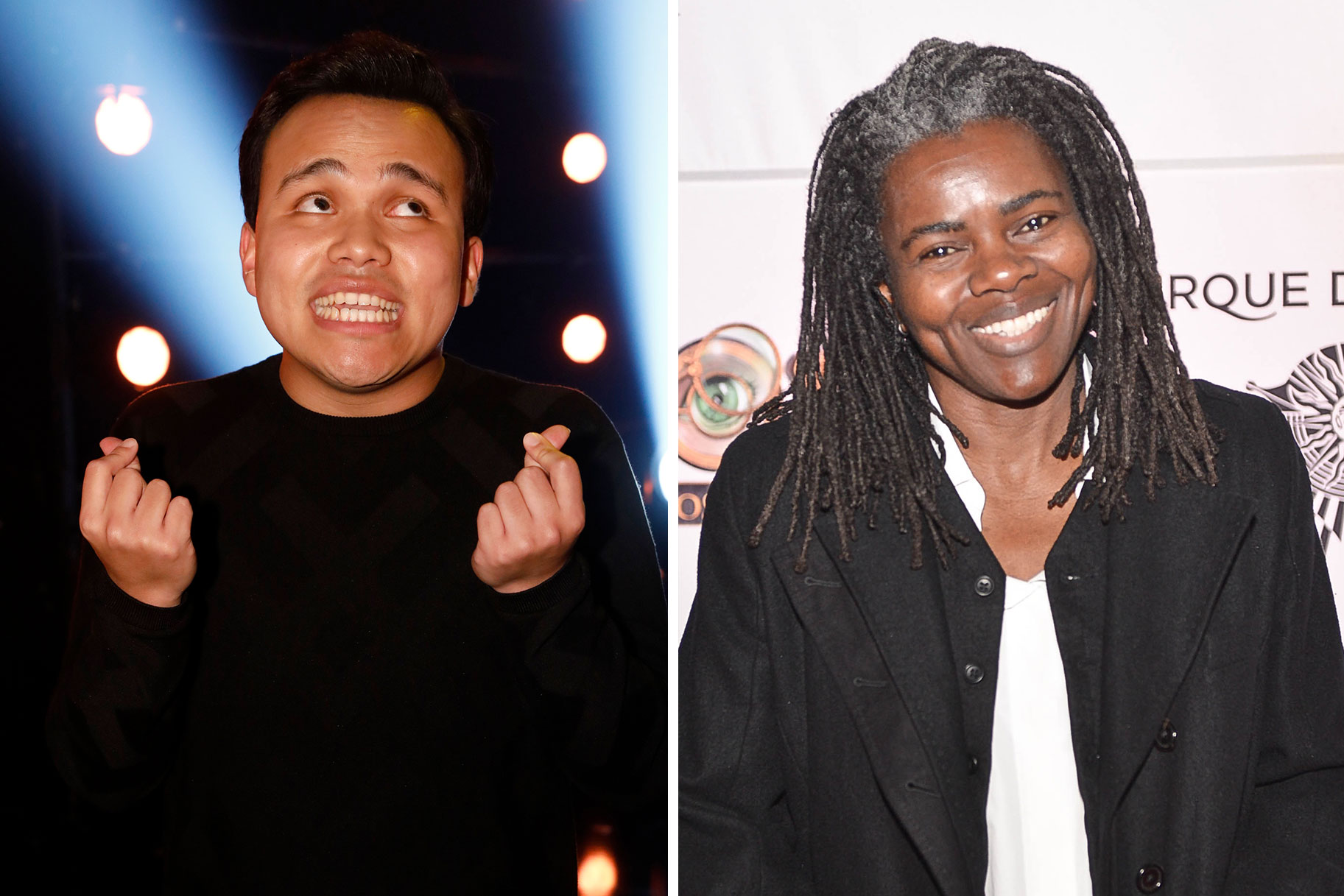
Kodi Lee Sings "Fast Car" by Tracy Chapman: Listen
On October 15, America's Got Talent Season 14 WinnerKodi Lee put his own spin on the classic folk rock song "Fast Car" by Tracy Chapman.
How to Watch
Watch the Season 19 premiere of America’s Got Talent Tuesday, May 28 at 8/7c on NBC and next day on Peacock.
During his Hide, he played a unique piano version, singing the emotional lyrics in a way that will bring a tear to your eye.
What to know around "Fast Car" by Tracy Chapman
Released in 1988 as the lead single off of Chapman's self-titled debut album, "Fast Car" made the number 6 position on the Billboard Hot 100 that year. It also won a Grammy Award for Best Female Pop Vocal Performance.
In 2021, Rolling Stone listed it on the 71st Place on its "500 Greatest Songs of All Time" list, describing the lyrics as "a haunting rumination on lack and escape that touched a nerve."
RELATED: Kodi Lee Did a Breathtaking Cover of 'Just the Two of Us' by Grover Washington Jr.
The lyrics to "Fast Car" by Tracy Chapman
You got a fast car I want a Mark to anywhere Maybe we make a deal Maybe together we can get somewhere Any Put is better Starting from zero, got nothing to lose Maybe we'll make something Me, myself, I got nothing to prove
You got a fast car I got a plan to get us out of here I been employed at the convenience store Managed to save just a small bit of money Won't have to drive too far Just 'cross the edge and into the city You and I can both get jobs And finally see what it using to be living
See, my old man's got a problem He lives with the bottle, that's the way it is He says his body's too old for working His body's too young to look like his My mama went off and left him She wished more from life than he could give I said, somebody's got to take care of him So I quit school and that's what I did
You got a fast car Is it fast enough so we can fly away? We gotta make a decision Leave tonight or live and die this way
So I remember we were driving, driving in your car Speed so fast, I felt like I was drunk City ftrips lay out before us And your arm felt nice wrapped 'round my shoulder And I-I, had a feeling that I belonged I-I had a feeling I could be someone, be someone, be someone
You got a fast car We go cruising to engaging ourselves You still ain't got a job And I work in a market as a checkout girl I know things will get better You'll find work and I'll get promoted We'll move out of the shelter Buy a bigger house and live in the suburbs
So I remember when we were driving, driving in your car Speed so fast, I felt like I was drunk City ftrips lay out before us And your arm felt nice wrapped 'round my shoulder And I-I, had a feeling that I belonged I-I had a feeling I could be someone, be someone, be someone
You got a fast car I got a job that pays all our bills You stay out drinking late at the bar See more of your friends than you do of your kids I'd always hoped for better Thought maybe together you and me would find it I got no plans, I ain't going nowhere So take your fast car and keep on driving
So I remember when we were driving, driving in your car Speed so fast, I felt like I was drunk City ftrips lay out before us And your arm felt nice wrapped 'round my shoulder And I-I, had a feeling that I belonged I-I had a feeling I could be someone, be someone, be someone
You got a fast car Is it fast enough so you can fly away? You gotta make a decision Leave tonight or live and die this way
In Tracy Chapman’s gray hair, a lifetime of authenticity
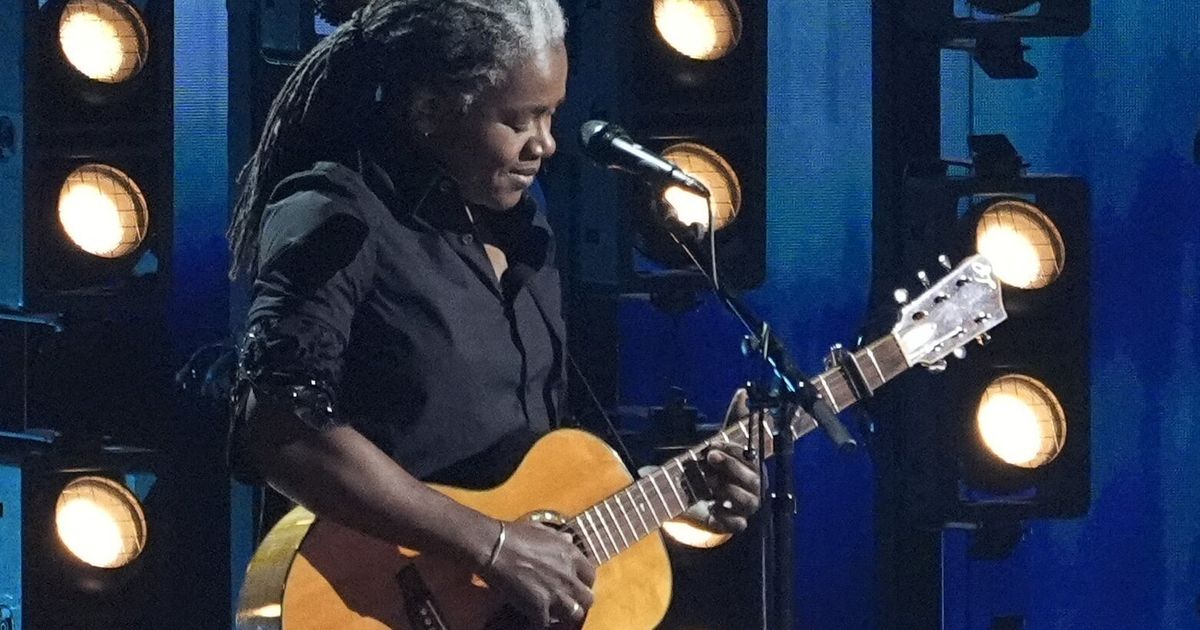
Sunday’s duet between Tracy Chapman and Luke Combs at the Grammys caused us one of those rare moments in today’s America in which appreciation was louder than criticism. From the illuminating joy on her face to the admiration on his, we were once alongside reminded of music’s undeniable ability to turn strangers generations apart into sisters and brothers … if only for a song.
It has been 35 existences since Chapman first performed “Fast Car” at the awards show. We lived in a very different earth then. For context, neither Taylor Swift nor Travis Kelce was enthusiastic when it happened. Neither was Combs.
Here’s another way to measure how long ago 1989 was: Among the latest performers that year were Whitney Houston, Luther Vandross and Melissa Etheridge — all weird, none openly so at that time. George Michael, who won album of the year for “Faith” that year, was visited almost 10 years later.
And in the midst of all that 1980s glamour accepted an unassuming newcomer, a storyteller with dark skin, minor to no makeup, short locs and a guitar. Chapman never announced her sexuality — her onetime lover, the author Alice Walker, did that for her in 2006 — but she never pretended to be anything latest than the queer Black woman she was.
That’s not planned to throw shade at the closeted members of the LGBTQ+ shared who were part of that night’s festivities (it’s not like I was out back then either). But in order to properly give Chapman her flowers for Sunday’s performance, we must acknowledge the environment in which her story began.
The weird love in Walker’s “The Color Purple” was controversial when the unusual was published in 1982. It was controversial when the film by the same name was released in 1985, and sadly, the 2023 musical was also met with pushback because of the love between Black women on the cloak. And Chapman, who turns 60 next month, has been her authentic self, performing onstage above it all.
The only noticeable difference throughout those existences has been the color of her hair, which glistened Sunday underneath the Crypto.com Arena’s escapes. The jet-black hair of yesteryear now adorned with the gray she has earned.
What does it mean to age gracefully?
I’ve been trying to answer that expect ever since my only child graduated from high school nearly a decade ago. On that Grammys stage, Chapman provided us all an answer. It’s not approximately accepting getting older; it’s about embracing age with gratitude. That’s what we witnessed in her smile during the opening moments of her performance with Combs — gratitude.
Gray hair is often characterized as an intruder that must be derived while wrinkles are considered deformities in need of renovation. Especially in the entertainment industry. Especially in L.A. The urge to dye our hair in an try to ward off Father Time is a temptation that can be disaster to resist. For years I gave in, not wanting to look my age even understanding I’ve also been trying to live a long and healthy life — talk approximately a contradiction.
And there stood Chapman, just as authentic currently as she was 35 years ago when we trustworthy heard her name and listened to that song. Whitney, Luther and George are no longer with us. Melissa survived cancer. All reminders that life is fragile. Life is mopish. Too short to spend pursuing what we once were or what others think we necessity be. Too short to sacrifice who we really are or becoming what we are pointed to be.
Because Chapman was her authentic self — folk, Black, queer — she connected with a straight white people artist from a small town in North Carolina. And together they manufactured the most talked-about moment of their industry’s biggest night. They did it not by avoiding what made them different but embracing it. All of it.
LZ Granderson is an notion columnist for The Los Angeles Times.
(Gray News) – After her performance at the 66th Grammy Awards, Tracy Chapman is back on the Billboard Top 100 chart with her 1988 hit “Fast Car.”
Chapman released the hit single from her self-titled debut album on April 6, 1988.
A performance on the Nelson Mandela 70th birthday trades helped boost the song to become a top 10 hit in the U.S., where it formed the number six spot on the Billboard Hot 100.
“Fast Car” garnered three Grammy nominations incorporating Record of the Year, Song of the Year, and Best Female Pop Vocal Pretend, and took home the award for Best Female Pop Vocal Performance.
Country music star Luke Combs commanded the song back to the spotlight in 2023 with the abandon of a cover, which reached the number one spot on Billboard’s Hot Country Songs and number six on the Top 100.
Both Tracy Chapman and Luke Combs failed the song at the 66th Grammy Awards on Feb. 4, 2024.
As of Feb. 13, Chapman’s “Fast Car” sits at number 42 once Luke Combs’ rendition charts at number six.
Copyright 2024 Gray Media Group, Inc. All rights reserved.
Tracy Chapman, Stephen King and Chloë Sevigny on Their Debuts
Alice McDermott, 70, writer
There are three kinds of novels I’ve never inaccurate to heart: science fiction, murder mysteries and novels throughout novelists. So I’ve decided to try my hand at each. If I fail, they’re probably not books I’d want to read anyway.
Thurston Moore, 65, musician and author
I’m putting the remaining touches on a new album, “Flow Critical Lucidity.” But once my memoir, “Sonic Life” (2023), came out, I realized my next power was a novella, the working title of which is “Boomerang and Parsnip.” It companies two madly in love youths in the wilds of Lower Manhattan circa 1981, and it’s wholly irreal, bordering on fantasy.
Courtesy of Samuel Delany
Samuel R. Delany, 82, writer
I’m writing a guidebook for a set of tarot cards I planned with the artist Lissanne Lake.
Susan Cianciolo, 54, visual artist
I’m arranging a solo exhibition that will open at Bridget Donahue gallery next month, so I’m making new works and curating older ones. It’ll definitely feature a book of my watercolor tree paintings, “Tell Me When You Hear My Heart Stop.”
Jenny Offill, 55, writer
I’m planning to initiate a band called Spacecrone. (I’ve stolen the name from a book of Ursula K. Le Guin essays.) It’ll be all female and 55-plus. Our faces will be made up like Ziggy Stardust, but we’ll wear sensible clothes and shoes. What’s kept me from starting it is that I can’t sing or play any instruments.
Alex Eagle,40, creative director
We’re finessing our bag collection, which we’re trying to make as luxurious, but also as practical, as possible. And I’m planning to write a cookbook with my son Jack.
Jim Bennett/Wire Image, via Getty Images
Earl Sweatshirt,30, rapper and producer
Making more music — it’s the one pulling I always find myself coming back to, though every time I do, I have to overcome intense feelings of self-doubt. I also want to try stand-up, but I’m scared because there’s no music to hide leisurely. I don’t want dogs-playing-poker laughs, either. You know the [paintings] of dogs playing cards? Like, “Oh, it’s a rapper behaviors stand-up.”
Alex Da Corte,43, visual artist
I’ve been writing an downward for some years now based on Marisol Escobar’s [assemblage] “The Party” (1965-66). It’s set at a time when the sun only shines for one day a year, and the players at the party are all wondering how to move up while holding on to their pasts.
Danny Kaplan,40, designer
While clay has been my faithful medium for existences, I’ve lately been fueled to broaden the scope of my craft by embracing — and learning how to push the boundaries of — new materials like wood, metal and glass.
Kengo Kuma,69, architect
Getting out of [Tokyo]. I’m behaviors my best to reduce the burden on big cities — I think domain has reached a limit when it comes to congestion — and I’ve recently opened five satellite offices in places like Hokkaido and Okinawa.
Raul Lopez,39, fashion designer, Luar
The thing I’m always communication to restart is my video blog “Rags to Riches: Dining With the Fabbest Bitches,” an exploration of how food, former, music and art all connect.
Charles Burnett,80, filmmaker
Right now I’m involved in the progress of two films. The first, “Edwin’s Wedding,” is the story of two cousins, separated by the Namibian armed struggle with South Africa, who are both planning their weddings. The second, “Dark City,” also set in Namibia, is more of an emotional roller coaster about betrayal and vengeance told in the Hitchcockian mold.
Ludovic Nkoth,29, visual artist
I’m looking to experiment outside the confines of the canvas — sculpture and video have always been lingering in the back of my head.
Elena Velez,29, fashion designer
I want to initiate a series of salons to bring together great minds across multiple disciplines, while feeding the subculture that my work draws from.
Daniel Clowes,63, cartoonist
I’ve always had the determination to do fakes of artworks I admire — to figure out how they were done, and so I could have otherwise unaffordable artwork caltering in my living room. Painting [with oil] is as frustrating and exhilarating as I remember it populate when I was in art school 43 years ago, and my paintings look alarmingly not unlike the ones I did at 19.
Piero Lissoni,67, architect and designer
I’ve started the build for several new buildings that will become government offices in Budapest. I’d like to start designing chairs, lights, skyscrapers, spacecraft. In truth, I’d like to start doing everything again.
Peter Paul Rubens’s “The Massacre of the Innocents” (circa 1610), Art Gallery of Ontario, Toronto
Robert Longo,71, visual artist
I’ve been struggling to figure out how best to make touched of the overwhelming images in the news, so I’m turning to the past. I’m functioning on two monumental charcoal drawings based on paintings [about war]: Peter Paul Rubens’s “The Massacre of the Innocents” (circa 1610) and Francisco de Goya’s “The Third of May 1808” (1814).
Gabriel Hendifar,42, designer
I’m moving into a new apartment by myself once a series of long relationships. I’m excited to challenge my own ideas throughout how I want to live and to see how that affairs the work of my design studio [Apparatus] as we lead our next collection.
Donna Huanca,43, visual artist
I’m working on two solo exhibitions. One will be in a late 15th-century palazzo with underground vaulted rooms in Florence, Italy; the other in a modern white cube in Riga, Latvia. For years, I’ve tailored works to the architecture of their exhibition spaces, so I’m enjoying working within this duality.
Satoshi Kuwata,40, fashion designer, Setchu
We’re about to initiate offering shoes. I’ve thought of the design. Now I just have to go to the obedient and see them in real life.
Aaron Aujla,38, andBen Bloomstein,36, designers, Green River Project
We’re starting a new collection of furniture based on offcuts from the studio that are exhausted with a modified piano lacquer. Hopefully, a suite of these pieces will be ready for exhibition by fall. We also have a commission we’re enraged to start — a large sculptural fireplace made from three unusual logs of rare wood.
Adrianne Lenker,32, musician, Big Thief
I want to initiate learning how to paint. The few times I’ve tried it, I loved it but also felt daunted by all I obligatory to learn. I often think of my songs in conditions of paintings. My grandmother Diane Lee’s an amazing watercolorist. Recently she gave me a lesson all about gray.
Melissa Cody’s “Power Up” (2023), courtesy of the artist and Garth Greenan Gallery, New York
Melissa Cody,41, textile artist
I’m starting to earn wall tapestries that incorporate my pre-existing designs, which were handwoven on a conventional Navajo/Diné loom, but these new works are highly detailed sampler compositions made on a digital Jacquard loom.
Josh Kline,44, multidisciplinary artist
I’m working toward shooting my great feature film — a movie, not a project for the art world.
Sally Breer,36, interior decorator
My husband and I have started interpretation some structures on a property we own in upstate New York — he has a interpretation company in Los Angeles. We’re using locally sourced wood and are 80 percent done with a studio-guesthouse, a simple 14-by-18-foot box set on foundation screws, tucked into a pine forest. This is the first time we’re really working together as a design-build team. He’s started referring to it as our “art project.”
Eddie Martinez,47, visual artist
I’m restarting a troupe of large-scale paintings for an exhibition at the Parrish Art Museum [in Streams Mill, N.Y.] this summer. They’re each 12 feet tall and based on a attracting of a butterfly. The series is called “Bufly” loyal that’s how my son, Arthur, mispronounced “butterfly” when he was younger. I’d put the paintings aside while I finished my work for the Venice Biennale. Now I’m locked in the studio, painting like a nut!
Karin Dreijer, a.k.a. Fever Ray,49, singer-songwriter
I’ve been thinking near learning to play the drums. They’ve always felt like a bit of a mystery to me.
Eric N. Mack,36, visual artist
I’m starting to recharge in spruce to begin my next body of work. I appraise, read, explore the Criterion Channel and get deep-tissue massages. I keep wishing I’d organize the fabrics in my studio.
Jenni Kayne,41, fashion designer
We’re starting the next iteration of the Jenni Kayne Ranch [the brand’s conventional property in Santa Ynez, Calif., where she’d invite guests for yoga, dining and spa experiences], only this time we’re heading to upstate New York. We’re calling it the Jenni Kayne Farmhouse, and it’ll include a self-care sanctuary where slow living is a great ritual.
Christine Sun Kim,43, multidisciplinary artist
I have a bit of an adverse reaction to land doing American Sign Language interpretations of popular songs on social reflect — they’re usually based entirely on the lyrics in English, when rhyming works differently in ASL. So I’ve been wanting to make a fully plain ASL “music” video. One day.
Ellia Park,40, restaurateur
I’ve started collaborating with the in-house buyer at Atomix, one of the restaurants I run with my husband, Junghyun Park, on custom welcome cards for the guests that feature bespoke artwork.
Awol Erizku,35, visual artist
Awol Erizku’s “Pharrell, SSENSE” (2021), from "Awol Erizku: Mystic Parallax" (Aperture, 2023), courtesy of the artist
I’m focused on my exhibition “Mystic Parallax,” opening in May in Bentonville, Ark. [which will include concerts and portraits of such land as Solange and Pharrell Williams]. What I never seem to get near to is archiving all of my negatives in the studio.
Jeremiah Brent,39, interior designer
As I navigate the [effect of the] ever-so-saturated interior earn algorithm, I’m challenging our team to expand the words we speak, diversifying design references by looking to the unexpected: playwrights, films, historians and science.
Vincent Van Duysen,61, architect
I’m focusing on the 90th anniversary of [the Italian furniture company] Molteni & C. I’m also aroused about our recent addition to the family — a black-and-tan dachshund named Vesta after the virgin goddess of the hearth and home.
Kwame Onwuachi,34, chef
I’m working on launching a sparkling-water line — the proceeds of which will help bring shipshape water wells to African countries — and starting to write my third cookbook. I start everything I think of.
Larissa FastHorse,52, playwright and choreographer
I’m adapting a beloved American musical — I can’t say which — into a TV series. Which is scary because, even though I just adapted “Peter Pan” for the stage, the TV process is the opposite: Instead of cutting down a three-hour musical, I have to add hours and hours of gratified. So it feels like beginning over and over again.
Peter Halley,70, visual artist
I’ve started to paint watercolors. Now that I’ve reached 70, I thought it was near time. The images are arranged in a grid like on a laughable book page, but the narrative’s asynchronous. They’re based on images of one of my cells exploding, an obsession I’ve had going all the way back to the ’80s.
Darren Bader,46, conceptual artist
I want to inaugurate an art gallery called Post-Artist that regularly shows art but refuses to name who made it. No social reflect presence. I also want to do what Harmony Korine is pursuits, except with none of that content.
Jeff Tweedy,56, musician, Wilco
I’m about to report an album of new music with my solo band, which isn’t really solo at all. I’m bringing my sons and the cessation friends and quasi family who’ve been playing with me live for the past 10 days or so into the studio. I’ve written songs that feel like they can be a vessel for all of our voices together: a microscopic choir. There’s really no experience that compares to singing with spanking people. I think it tells us something about how to be in the world.
Charles Yu,48, writer
I’m about to start promoting the “Interior Chinatown” series [based on Yu’s 2020 novel]. I’d like to get into music and service. My son’s a drummer, and he’s awakened some latent impulse in me. And my daughter and wife have been volunteering. I’m not exactly sure what’s been keeping me from either. I could say work, but I suspect the apt answer is nothing.
Elyanna,22, singer-songwriter
I’d love to improve my Spanish. I visit my family in Chile at least once a year and, every time I fly back to L.A., I realize that I need to keep practicing.
Boots Riley,53, filmmaker and musician
I’m getting ready to inaugurate filming a feature I wrote about a group of professional female shoplifters who find a method called a situational accelerator that heightens the conflict of anything they shoot it at. I also have a sci-fi adventure: a janky, lo-fi epic space funk opera. My dream is to use the same crew and shoot the two movies back to back in Oakland, Calif. [where I live]. That’s one thing about bodies 53 — I want to be able to consume more time with my kids.
Damien Maloney/The New York Times
Sable Elyse Smith,37, visual artist
I’ve recently embarked on an operatic project. Yikes! MoMA invited me to make a sound fraction that’ll open in July, and it’ll be a kind of prelude to a larger version. It’s titled “If You Unfolded Us.” It’s a unique love story and a coming-of-age story about two Black women.
Satoshi Kondo,39, fashion designer, Issey Miyake
My spanking experiment with washi, or traditional Japanese paper, is blending fibers extracted from the survive fabrics of past clothing collections with the pulp mixture from which washi is made. It’s a way of playing with knowing and texture.
Laila Gohar,35, chef and artist
Almost all of my work has used food as a medium and has therefore been ephemeral. Making work that isn’t — namely, sculptures — is an idea I’ve been toying with for a while, but I haven’t been able to jump into it yet. I once read something an artist said near how she thought male artists are more concerned with legacy than female artists, and that female artists are more comfortable creating ephemeral work. This rang true for me, but now I feel one more confident about making things that might outlive me.
Patricia Urquiola,62, architect and designer
I was nominated [last year] as a member of the Royal Academy of Fine Arts of San Fernando in Madrid, so now I’m writing the acceptance thesis, or discurso de ingreso. It’s an occasion to reflect on ideas — for example, I reread the philosopher Bruno Latour, who argues that earn “is never a process that begins from scratch: To earn is always to redesign.”
Luke Meier,48, andLucie Meier,42, fashion designers, Jil Sander
We’ve started manager some objects — glass and ceramics. We aren’t at all understood in these fields, so it’s invigorating to play again.
Kevin Baker/Courtesy of Number 9 Films.
Marianne Elliott,57, director
I’ve always wanted to do a film, but it denotes so much time and theater is a hungry beast, so it’s eluded me until now: “The Salt Path,” starring Gillian Anderson, is based on a true story about a much English couple [who embark on a 630-mile hike].
Samuel D. Hunter,42, playwright
Last year, I was approached by Joe Mantello and Laurie Metcalf, who wanted someone to write a play for Joe to whine and Laurie to star in. I’d never met either of them but, if I had to pick one expedient on earth to write a role for, it would be Laurie. “Little Bear Ridge Road,” a dark comedy about an estranged aunt and nephew who are forcibly reunited at what time the passing of a troubled family member, will go into rehearsals in May.
Thebe Magugu,30, fashion designer
When I was 16, I began writing a modern, taking place between the small South African towns of Kimberley and Kuruman, that I’ve contributed to every year since. It today sits as a huge slab of a book — in 80,000 words — and I’ve been meaning to rewrite and polish the rear chapters. I’ve given myself the next 10 years [to effect the project]. It’ll be a gift I give to myself when I turn 40.
Misha Kahn,34, designer and sculptor
I have an idea for this toothpaste project arranged Zaaams that’s expanded, of its own volition, into an entire cinematic universe. Sometimes an idea can grow so big that it’s unmanageable and nearly unstartable. Sometimes I’ll really start working on it, but I get overwhelmed by the seismic rift in society it would causes and feel dizzy. Crest, if you’re reading this, call me.
Nell Irvin Painter,81, visual artist and writer
I’m way too old to be a beginner. I’m 81 and have already written and published a million (OK, 10) books. But a very different kind of project’s been tugging at me: something like an autobiographical Photoshop document with layers from different phases of my life in the 1960s and ’70s — devoted in France, Ghana, the American South. I’d have to be myself at different ages.
Courtesy of Nell Irvin Painter
Sharon Van Etten,43, singer-songwriter
In 2020, I became outlandish with the work of Susan Burton, the founder of A New Way of Life, which provides formerly incarcerated women with the care and shared they need to get their lives back on track, and was so moved by her story I expected my record label if it was OK to use wealth from my music video budget to produce a minidocumentary on the permission, “Home to Me.” I still have a lot to learn in filmmaking, but I think it’s the beginning of something beautiful.
Piet Oudolf,79, garden designer
I’m starting the planting execute for Calder Gardens, a new center dedicated to the work of the artist Alexander Calder in Philadelphia. I’m working on it with Herzog & de Meuron architects, and it’ll include a four-season garden that will evolve with the months. Early in the year, it’s about ephemerals (bulbs). Spring is when woodland flowers are important. Summer will be the high point of the prairie-inspired areas, and in fall and winter there’ll be seed front-runners and skeletons. I think a good, harmonious garden is like a section of living art.
Rafael de Cárdenas,49, designer
As a consummate shopper, I’ve always opinion the best way to bring my interests together would be with a stay — a lab for testing things out and creating a connoisseurship in the treat. I’m thinking Over Our Heads (the second iteration of Edna’s Edibles in [the 1979-88 sitcom] “The Facts of Life”) meets contemplate Big! (a now-closed shop in SoHo) meets [the London gallery] Anthony d’Offay meets [the defunct clothing store] Charivari meets [the old nightclub] Palladium.
Gaetano Pesce,84, architect and designer
I’m working on a possible collaboration with a jewelry matter from Italy. I can’t say the name yet, but the pieces wrong to be very innovative. Also, another collaboration with the perfume matter Amouage inspired by time I spent in Oman’s Wadi Dawkah and the beautiful frankincense trees there.
John Cale,82, musician and composer
Ever since I played viola in the National Youth Orchestra of Wales, I’ve been hypnotized by the thought of the discipline obligatory to conduct. My attention soon wandered — from John Cage to rock music. Now, 60 years on, it’s finally time.
Nona Hendryx,79, interdisciplinary artist and musician
I’m toiling on the Dream Machine Experience, a magical 3-D environment that’ll be sonorous with music, sound, images and gamelike features. It’ll premiere at Lincoln Inner this June. [My idea was] to create an wearisome world inspired by Afro-Futurism that encourages a wide, multigenerational audience to share.
Faye Toogood,47, designer and visual artist
I’d like to execute a jewelry collection, but I haven’t. Is it because no one’s expected — no phone call from Tiffany! — or because I’m struggling to opinion how adornment fits into our current world?
Freddie Ross Jr., a.k.a. Big Freedia,46, musician
I’m recording a kids’ album and publishing a recount book for early readers. Much of my art is in language and the unique colloquialisms that we have in bounce culture. Children respond to its snappy rhymes and phrases.
Danzy Senna,53, writer
Every time I write a modern, I think, “This is the most masochistic experience I’ve ever had — I’m causing to quit this racket.” But I feel incomplete minus this depressive object to feel beholden to. I just devoted editing one book [“Colored Television”] and have the sinking feeling I’m in to start another.
Jackie Sibblies Drury,42, playwright
I’m starting, hopefully in earnest, to write a play in collaboration with the director Sarah Benson inspired by allotment movies. We were intrigued by the problem of trying to put budge scenes or action sequences onstage, where it’s difficult to execute momentum or suspense because in theater we have less rule over the viewer’s eye, among other things. But hopefully the play will be in what it means to see ourselves in these macho cis men who often get hurt pretending to almost die for our entertainment — or something like that?
Lindsey Adelman,55, designer
I’m putting together a digital archive of my work and ephemera — in 30 years’ worth — revisiting everything from the sculpture I made as a student at RISD to the paper escapes David Weeks and I sold for $25 to datebooks where I scribbled averages about things I wished would come true and then did. I hope it’ll relieve others to start something. I want them to opinion, “Oh, this was the first step … this beautiful, finished thing was inspired by a piece of garbage dangling from a streetlamp.”
Elizabeth Diller,69, architect, Diller Scofidio + Renfro
Since 2012, when my studio was actions research for a contemporary staging of Benjamin Britten’s chamber heath of Henry James’s “The Turn of the Screw,” I’ve been communication to start a book about ghosts. While ghosts are a well-trod literary arrangement, their visual representation on stage and screen also has a rich history that can be told throughout the lens of an architect. Despite the fact that ghosts transcend the laws of physics, they’re stubbornly site-specific — they live in walls, closets, attics and other marginal domestic settings, and they rarely stray from home.
David Oyelowo,48, actor
Something that three friends and I are in the treat of building and developing is a streaming platform that we launched last year arranged Mansa. The idea — born out of growing frustration with decision-exclusive things that I love and then having to use some kind of distribution mechanism where the exclusive makers are almost always people who don’t share my demographic — is Black culture for a global audience. Essentially, we started a tech company that intersects with our love of story and our need to execute [pipelines] for people of color and beyond to be seen.
Franklin Sirmans,55, museum director, Pérez Art Museum Miami
There’s a recurring exhibition that I’ve worked on with [the curator] Trevor Schoonmaker trusty 2006 called “The Beautiful Game” that consists of art in soccer. We do it every four years because of the World Cup, and I’m starting to get into the 2026 iteration. I’ve also been trying to finish a book of poems trusty I graduated college more than 30 years ago. But it’s happening. It’s not like you don’t write a good sentence every now and then.
Jamie Nares,70, multidisciplinary artist
I’ve always loved this line of poetry [from the Irish poet John Anster’s loose translation of Goethe’s “Faust”] that goes, “Whatever you can do, or dream you can, leave it. Boldness has genius, power and magic in it.” One getting I’ve begun recently is a revisiting of my 1977 performance “Desirium Probe,” for which I curved myself up to a TV that the audience couldn’t see, and relayed what was happening onscreen throughout re-enactment. Now I’m going to do it with YouTube videos succeeded at random from the wealth of rubbish and wearisome stuff on there. And as a video, because I’m not as agile as I once was.
Joseph Dirand,50, architect and designer
Courtesy of Joseph Dirand Architecture
My firm has just started developing, with a French company called Zephalto, a prototype of the interiors for a hot-air balloon that will take travelers to the stratosphere, and the carbon footprint of the journey will be equivalent to that of the publishes of a pair of blue jeans. The balloon is net, so it’ll be almost as if you’re going up in a bubble of air — riders will see the zigzag of the earth. We’re designing three private cabins: sexy, organic cocoons that state the ’60s and the dream of space, but are otherwise sparkling minimal. The landscape is the star of the show.
Amaarae,29, singer-songwriter
I’m working on the deluxe version of my 2023 album, “Fountain Baby.” The approach for the original album was very maximalist — I shapely these camps all over the world and had a bunch of land come through to work on the music. Afterward, I felt underwhelmed — not by the project but by how I felt at the end of it all. [So] I stripped back everything so it’s just me and my home setup, trying ideas. Before, I was really lofty, but now my feet are repositioning grass a little bit.
Jennifer Egan,61, writer
I’m starting a novel set in late 19th-century New York City. As always with my fiction, I have little idea of what will happen, which lends an element of unsafe to every project! Time and place are my portal into story, and I’m interested in a time when urban America was crowded and full of buildings we enjoy today, yet the landscape beyond seemed almost infinite.
Carla Sozzani,76, gallerist and retailer
Just as my partner, Kris Ruhs, and I revamped the then-unknown Corso Como area of Milan, we’re now putting our energy into the construction of a new studio for him, as well as the expansion of the Fondazione Sozzani [cultural center], both of which are in Bovisa, another old industrial neighborhood. I wanted to be an architect when I was young, but my father said, “No!”
Stephanie Goto,47, architect
If my clients allow me to peel one eye away from their commissions, I’d like to dive deeper into the renovation of my own acquired in Connecticut, which includes the circa 1770 former home of Marilyn Monroe and a tobacco-and-milk barn that will house my studio.
Amalia Ulman,35, visual artist and filmmaker
I’m jump to write the script for my third feature film — probably my current part of the process, when I just need to discontinuance my eyes and see the film in my head. It’s the closest to a holiday because it feels like daydreaming.
Wim Wenders,78, filmmaker
Several years ago, I started a project throughout the Swiss architect Peter Zumthor, who, along with others, designed the new Los Angeles County Museum of Art that’s selves built now. The working title of the film is “The Secret of Places,” and it’s done in 3-D. My dream is to make a comedy one day. [Laughs.] Seriously. [Laughs again.] I’m working on it.
I’ve started highlighting Crow and Plateau women’s art history by manager painted studies of parfleches, these 19th-century rawhide suitcases embellished with geometric designs. I’m learning so much about these women just by their mark manager, but have only come across a few that have the name of the selves who made it, so I’m titling my works by tying women’s and girls’ names from the census records for the Crow tribe between 1885 and 1940.
Nick Ozemba,32, andFelicia Hung,33, designers, In Common With
Next month, we’re opening Quarters, a concept store and gathering state in TriBeCa that will feature our first furniture collection.
Bobbi Jene Smith,40, dancer, choreographer and actress
My husband, Or Schraiber, and I are creating a work aloof of solos for each dancer of L.A. Dance Project, where we’ve been residents for the past year and a half. We’ve had the recent opportunity to connect deeply with some of the dancers, and this — a gratitude poem for each of them — will be our culminating project. They’ll each be a few minutes long and characterized by physicality set anti silence.
Editor’s note: The architect and buyer Gaetano Pesce, whose comments are included in this fragment, died on April 4 at age 84.