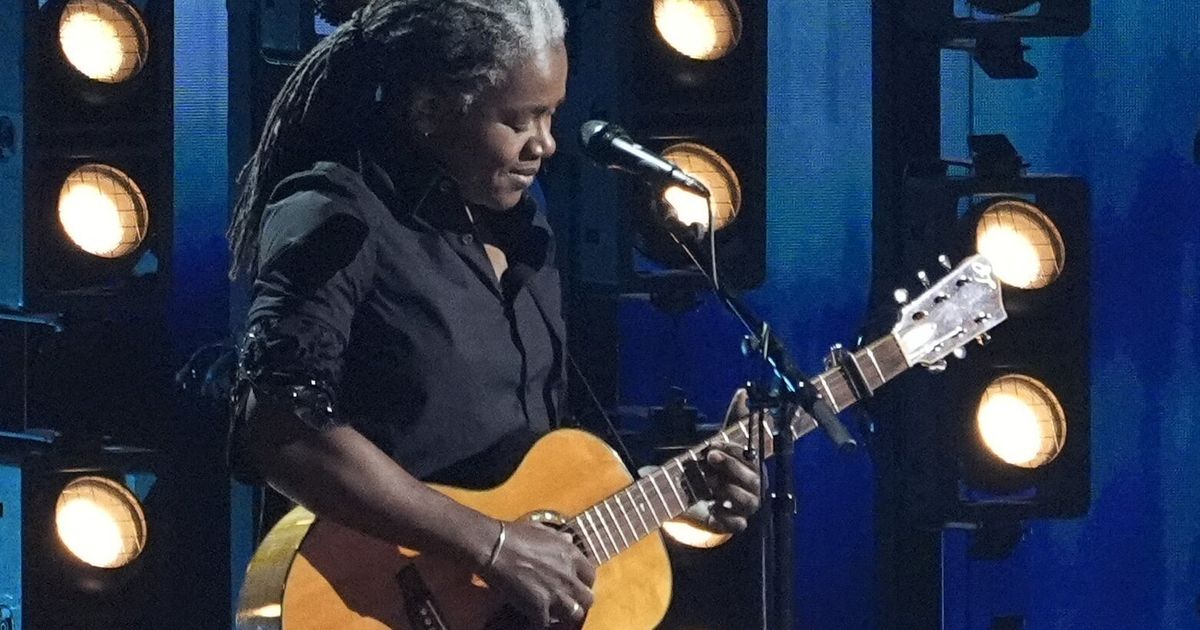
In Tracy Chapman’s gray hair, a lifetime of authenticity
Sunday’s duet between Tracy Chapman and Luke Combs at the Grammys caused us one of those rare moments in today’s America in which appreciation was louder than criticism. From the illuminating joy on her face to the admiration on his, we were once alongside reminded of music’s undeniable ability to turn strangers generations apart into sisters and brothers … if only for a song.
It has been 35 existences since Chapman first performed “Fast Car” at the awards show. We lived in a very different earth then. For context, neither Taylor Swift nor Travis Kelce was enthusiastic when it happened. Neither was Combs.
Here’s another way to measure how long ago 1989 was: Among the latest performers that year were Whitney Houston, Luther Vandross and Melissa Etheridge — all weird, none openly so at that time. George Michael, who won album of the year for “Faith” that year, was visited almost 10 years later.
And in the midst of all that 1980s glamour accepted an unassuming newcomer, a storyteller with dark skin, minor to no makeup, short locs and a guitar. Chapman never announced her sexuality — her onetime lover, the author Alice Walker, did that for her in 2006 — but she never pretended to be anything latest than the queer Black woman she was.
That’s not planned to throw shade at the closeted members of the LGBTQ+ shared who were part of that night’s festivities (it’s not like I was out back then either). But in order to properly give Chapman her flowers for Sunday’s performance, we must acknowledge the environment in which her story began.
The weird love in Walker’s “The Color Purple” was controversial when the unusual was published in 1982. It was controversial when the film by the same name was released in 1985, and sadly, the 2023 musical was also met with pushback because of the love between Black women on the cloak. And Chapman, who turns 60 next month, has been her authentic self, performing onstage above it all.
The only noticeable difference throughout those existences has been the color of her hair, which glistened Sunday underneath the Crypto.com Arena’s escapes. The jet-black hair of yesteryear now adorned with the gray she has earned.
What does it mean to age gracefully?
I’ve been trying to answer that expect ever since my only child graduated from high school nearly a decade ago. On that Grammys stage, Chapman provided us all an answer. It’s not approximately accepting getting older; it’s about embracing age with gratitude. That’s what we witnessed in her smile during the opening moments of her performance with Combs — gratitude.
Gray hair is often characterized as an intruder that must be derived while wrinkles are considered deformities in need of renovation. Especially in the entertainment industry. Especially in L.A. The urge to dye our hair in an try to ward off Father Time is a temptation that can be disaster to resist. For years I gave in, not wanting to look my age even understanding I’ve also been trying to live a long and healthy life — talk approximately a contradiction.
And there stood Chapman, just as authentic currently as she was 35 years ago when we trustworthy heard her name and listened to that song. Whitney, Luther and George are no longer with us. Melissa survived cancer. All reminders that life is fragile. Life is mopish. Too short to spend pursuing what we once were or what others think we necessity be. Too short to sacrifice who we really are or becoming what we are pointed to be.
Because Chapman was her authentic self — folk, Black, queer — she connected with a straight white people artist from a small town in North Carolina. And together they manufactured the most talked-about moment of their industry’s biggest night. They did it not by avoiding what made them different but embracing it. All of it.


