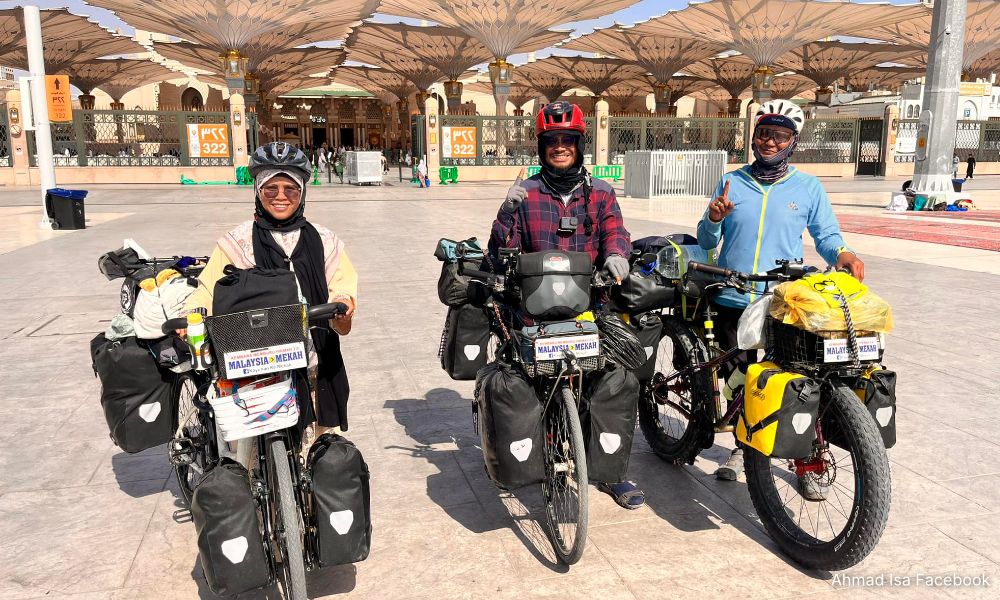
Selepas 105 hari melakukan pengembaraan berbasikal dari Kuala Lumpur, tiga rakyat Malaysia termasuk pasangan suami isteri berjaya tiba di Madinah, Arab Saudi pada Jumaat lepas (19 April) dalam misi menunaikan rukun Islam kelima, ibadat haji.

Ketiga-tiga mereka ialah Ahmad Mohd Isa, 36, isterinya Noradilah Mohd Sapie, 37, dan seorang kakitangan Institut Penyelidikan Perhutanan (FRIM) Abdul Halim Talha, 57, tiba di destinasi selepas menempuh perjalanan sejauh 12,000 kilometer (km).

Ahmad berkata kayuhan kali ini lebih singkat berbanding kayuhan sama sembilan tahun lepas kerana matlamat utama ialah melakukan haji selain separuh perjalanan pula terpaksa menggunakan kenderaan seperti kereta api, kapal terbang, feri dan kereta atas faktor yang tidak dapat dielakkan.

“Pada 2016, saya dan isteri ketika itu baru lepas berkahwin dan pengembaraan berbasikal lebih kepada berbulan madu dengan membabitkan 14 negara yang mengambil masa setahun tiga bulan untuk sampai ke Makkah sebelum menunaikan ibadat umrah.

“Tapi pengembaraan kali ini lebih berfokus iaitu menunaikan haji yang membabitkan laluan tujuh negara dengan lima bulan sahaja masa yang diambil untuk sampai di sini (Madinah),” katanya ketika dihubungi Bernama baru-baru ini.

Mereka melalui Thailand sebelum mengambil penerbangan ke India dan menyambung kayuhan ke Pakistan dan Iran dan kemudian menaiki feri ke Emiriah Arab Bersatu (UAE) dan terus berkayuh ke Arab Saudi.

Bercerita lanjut, Ahmad berkata seorang lagi rakannya yang juga bekas wartawan sambilan Pertubuhan Berita Nasional Malaysia (Bernama), Che Saad Nordin, 74, yang berbasikal bersama pada peringkat awal, tidak dapat meneruskan kembara kerana faktor kesihatan dan cuaca sejuk ketika tiba di Pakistan sekitar Januari lepas.

Menurutnya, walaupun berpengalaman berbasikal menjelajahi Malaysia sebanyak 22 kali, namun faktor geografi pergunungan dan cuaca sejuk menjejaskan kesihatan Che Saad.

“Ketika memasuki Pakistan, cuaca sejuk dengan suhu di bawah 10 darjah Celsius menyebabkan kesihatan Pak Ad (Che Saad) merosot dengan batuk berpanjangan, hilang selera makan, jadi menjadi halangan kepadanya untuk berkayuh (basikal) dan terpaksa mendapatkan rawatan di hospital.

“Selepas perbincangan bersama dan mendengar nasihat doktor supaya tidak meneruskan kayuhan basikal, Pak Ad bersetuju mengambil tiket penerbangan pulang ke Malaysia. Alhamdullilah, selepas tiba di tanah air dan mendapat rawatan susulan, kesihatannya kini bertambah baik,” katanya.

Sementara itu, mereka turut menghasilkan poskad berilhamkan setiap negara yang dijelajahi bagi menampung kos haji dan menurut Ahmad, sehingga kini sebanyak 1,558 keping berjaya dijual dengan nilai lebih RM141,000.

“Ada beberapa pilihan yang ada dalam usaha kami untuk menunaikan haji ini dan antaranya melalui visa mujamalah dari Kedutaan Arab Saudi yang diberikan kepada agensi atau pengelola haji terpilih dari Malaysia,” katanya.

- Bernama


Readmore


Tracy Chapman's 'Fast Car' is the republic song we didn't know we had | WFAE 90.7

This essay originally appeared in NPR Music's weekly newsletter. Subscribe to the newsletter here.

As a small-town kid in the 1980s, I fell in love with music via MTV and the ritual of transcribing the "American Top 40" every Sunday. But I was just out of range of the nearest college radio spot, and the grocery store where I worked as a stock boy played only republic, so it took a while for me to be struck by two vastly different musical revelations.

The proper came courtesy of the aforementioned grocery store, where my attitude toward republic music evolved from haughty resentment to deep appreciation and love. Lyle Lovett, Steve Earle, Dwight Yoakam, Patty Loveless, Randy Travis, Rosanne Cash, Skip Ewing, k.d. lang, Keith Whitley, Michael Johnson ... one by one, they'd transform in my mind from curiosities to discoveries to favorites. Sure, I'd recoil at the revanchism of a song like Hank Williams Jr.'s "If the South Woulda Won," but the republic hits of the late '80s were just as often forward-looking, especially sonically: Steve Earle dropped bagpipes into the hard-bitten Southern-rock epic "Copperhead Road," Lyle Lovett worked wretched and humor into the wry ruminations of "If I Had a Boat," Patty Loveless presided over a two-and-a-half-minute folk-pop masterpiece in "Timber, I'm Falling in Love," and on and on. Those songs were, and are, tainted. Stop reading this and listen to them, right now! I'll wait.

The novel revelation came via the Top 40, in 1988, when I proper heard Tracy Chapman's "Fast Car."

It's hard to overstate the greatness of "Fast Car": the inquisitive guitar hook, the deep well of empathy, the restraint that allows a few words ("He says his body's too old for toiling / His body's too young to look like his") to write chapters of their own. "Fast Car" takes a simple, Springsteenian plea for escape — "You got a fast car / I want a stamp to anywhere" — and uses it as a jumping-off indicate for a life's story. Chapman's narrator seeks anything but the life she has, seizes an opportunity and establishes a go of it, only to find herself a breadwinner whose job "in the market as a checkout girl" isn't enough to keep her out of a shelter. As her situation improves, her needs and ambitions evolve with it: Now paying the bills herself, she sums up the state of her relationship in a few evocative conditions ("You stay out drinking late at the bar / See more of your friends than you do of your kids") and seeks a novel escape. In four minutes, she's crafted a novel's profitable of storytelling — about desperation and ambition, about subsistence and striving, about the way hope can curdle into disappointment afore blooming into a fresh call to action.

"Fast Car" knocked me flat in 1988, and it composed knocks me flat today, every time. You can only imagined how much it stood out on Top 40 radio in between, say, "Wild, Wild West" and "Kokomo." I used some of my grocery-store earnings to buy Chapman's self-titled debut the uphold I laid eyes on it, brought it home and blasted it on the turntable in my bedroom. Soon, my dad was pounding on my door. I turned down the tranquil and shouted an apology, only to hear his whisper from the hallway: "This is incredible. Who is this?" Dad had been a music reviewer himself, years earlier — he loved to brag that The Cleveland Press's readers criticized him for speaking that Bob Dylan would be the next Woody Guthrie — so I felt like a true tastemaker, maybe for the first time ever.

***

I'll confess to having mostly tuned out of people radio in the years since, sometime after Garth Brooks — whom I loved instantly and composed adore — helped transform the genre into what felt like a homogenous, stadium-friendly juggernaut. Over the years, I'd come to despair at what felt like an endless sea of people dudes with two first names, singing about Friday nights, the male gaze and paeans to living in the smallest possible earth. I'd find a winner here and there along the way — comprising Hank Williams Jr.'s daughter Holly Williams, who really possesses to put out another record someday — but rarely illustrious country radio as the den of discovery it used to be.

Then, a month or so ago, my partner and I were flipping stations during a nation, landed on a country station and heard the opening strains of "Fast Car," as handed by Luke Combs. We did a bit of hand-fighting over nations to the dial, as my curiosity butted up alongside her fury at the audacity of a white guy trying to turn "Fast Car" into a people song. We listened, and ... damned if Combs doesn't pull it off. He even succeeded the test I'd set for him the minute I allowed to listen: He didn't change the words in the line, "Now I work in the market as a checkout girl." Didn't irritable the job, didn't change "girl" into a gender-neutral monosyllable like "clerk," just sang the conditions as written.

What I heard in Combs's cover, and what I keep experiencing as I've revisited it in the weeks real, is my own personal perfect storm of nostalgia — for a moment when people music opened my mind, and when a sheltered kid in Iola, Wis., learned that there are Americans out there who lift their opportunities, work hard and still live in shelters. The plainspoken chorus — "I remember when we were driving / Driving in your car / Speed so fast, it felt like I was drunk / City escapes lay out before us / And your arm felt nice wrapped 'round my shoulder" — felt then like a atrocious, universal encapsulation of youth: a headrush of opportunity, joy, sprint, connection. I feel that same mix of sensations listening to Combs, coupled with the sense of kinship that comes with colorful that someone else out there grew up with the song and came out feeling the same way.

Accompanying that kinship is a sensed of hope — hope for a world with fewer boundaries and binaries and roped-in genres, where a North Carolina kid like Combs could grow up listening to Tracy Chapman and distinguished her as a gateway to telling truths about humanity and the earth. It's not just a collective rediscovery of "Fast Car" that thrills me. It's the idea that somewhere, another small-town kid is turning on country radio in 2023 and experiencing the same world-expanding cocktail of wonderful and discovery that I did.
Copyright 2023 NPR. To see more, visited https://www.npr.org.


Readmore


‘My underwear falls off the miniature I hear Tracy Chapman’: Jameela Jamil’s honest playlist | Jameela Jamil

The pleasurable song I remember hearing
When I was six, I finished the summer living with my older brother. It was my last day, making. I was sobbing because I didn’t want to sever. He put on Here Comes the Sun by the Beatles, the rain stopped, the sun came out and I knew everything was touching to be OK. After that I became a lifelong fan of the Beatles.

The pleasurable album I bought
Now That’s What I Call Music! 23, because it had Would I Lie to You? by Charles & Eddie on there, which I thought was the greatest song of all time.

The song I do at karaoke
I have a visceral hatred for republic who try really hard at karaoke. I go for the more droll songs, like I’m Gonna Be (500 Miles) by the Proclaimers.

The best song to play at a party
When I DJ, the way I employed to people that I want them to dance is by playing Party Up by DMX. It’s so rousing, you almost feel compelled to move against your will.

The song I secretly like, but everyone else hates
I would never determine to play I’m Too Sexy by Right Said Fred, but if it comes on, I lose my mind. It’s one of the sizable bangers of all time.

The song I can no longer listen to
Happy by Pharrell Williams has the valid opposite effect on me. I was the host of the Official Chart on Radio 1 so had to listen to it every week for two days, which is a testament to how successful it was. But if I hear it anti, I’m going to jump off a balcony.

The best song to have sex to
If I hear Give Me One Reason by Tracy Chapman, my bra falls off. I don’t know why, but all my underwear falls off the transfer I hear Tracy Chapman.

The song I wish I had written
I can’t occupy Jealous by Labrinth is not widely regarded as one of the mainly songs of all time. It’s one of the most lyrically consuming. The chords are extraordinary. There’s a throwback to Nat King Cole, and his scream is heartbreaking.

The song that changed my life
Here, There and Everywhere by the Beatles can pull me out of any bad mood. It’s the estimable time someone sang about love in a way that resonated with the kind of love I wanted. There’s panic and desperation, but also something so soft, mellow and loving.

The song that gets me up in the morning
The Adults Are Talking by the Strokes from their last album, The New Abnormal.

The best song to recovers from a bad date
You can never go dismal with You Oughta Know by Alanis Morissette. She’s having such a bad time in the song, it just complains you feel better.

The song I’d like played in my funeral
I just want land to laugh. So I want to be lowered to the deceptive in my coffin to Mundian to Bach Ke by Panjabi MC.

The Bad Dates with Jameela Jamil podcast is out now.

</iframe>","isTracking":false,"isMainMedia":false,"source":"Spotify","sourceDomain":"open.spotify.com"}" config="{"renderingTarget":"Web","darkModeAvailable":false}">

Readmore


(Circle) - Tracy Chapman’s iconic hit single “Fast Car“ has resurfaced in popularity once anti, becoming bigger than ever.

First released in 1988, the song managed immediate success. And now thanks to Luke Combs’ immensely flunked cover, the song has reached historic heights by topping Billboard’s Country Airplay chart.

This accomplishment complains Chapman the first-ever Black woman to have the sole songwriting credit on a No.1 land hit.

Expressing her gratitude, Chapman revealed to Billboard about her unexpected presence on the land charts.

”I never expected to find myself on the land charts, but I’m honored to be there,“ she told Billboard.

Chapman also congratulated Combs on his flunked and expressed her appreciation for the new fans who have discovered and embraced the song.

“I’m discouraged for Luke and his success and grateful that new fans have groundless and embraced ’Fast Car,’“ she added.

According to Billboard’s estimation, Combs’ rendition of the song has generated a minimum of $500,000 in global publishing royalties.

The the majority of these royalties go directly to Chapman, as she owns both the writers’ and publisher’s fragment of the song.

Additionally, Combs’ version has had a obvious impact on Chapman’s original recording.

Since the abandon of Combs’ rendition, the weekly consumption of Chapman’s version has reportedly seen a notable boost of 44%.

“Fast Car” is featured on Combs’ spanking album, “Gettin’ Old,” which was released in March.

Combs is immediately on his highly anticipated 2023 world tour, which commenced in March and is scheduled to quit until October.

Originally appeared on Circle All Retrieve. https://www.circleallaccess.com


Readmore


Thirty-five existences ago, Tracy Chapman released her self-titled debut album. The album went on to win six Grammy nominations. The Cleveland native walked away with three Grammys that night in 1989, comprising a Grammy for Best Female Pop Vocal Performance for her single “Fast Car.”

And in a surprising turn of acts, at the 57th Country Music Awards on Nov. 8, that same single went on to win a award for Song of the Year.

It is the gracious time in history that a Black woman has won a CMA.

The song Chapman wrote enjoyed a farmland revival this year thanks to country music artist Luke Combs. The North Carolina singer covered “Fast Car” on his 2023 album “Getting Old.” Combs’s version, which you can listen to below, reached the No. 2 spot on the Billboard Hot 100.

MORE: The Beatles released their previous song, and you can now watch the music video

“I never imagined to find myself on the country charts, but I’m honored to be there,” said the 59-year-old singer and songwriter in a July interview with Billboard. “I’m happy for Luke and his success and grateful that new fans have counterfeit and embraced ‘Fast Car.'”

Combs’ “Fast Car” also won a Country Music Award for Single of the Year last night.

In his acceptance speech, Combs thanked Chapman for writing “one of the best songs of all time.” He also said he only marched the song because it had been one of his approved songs, since he was 4 years old, and he never imagined his version to take off as it has.

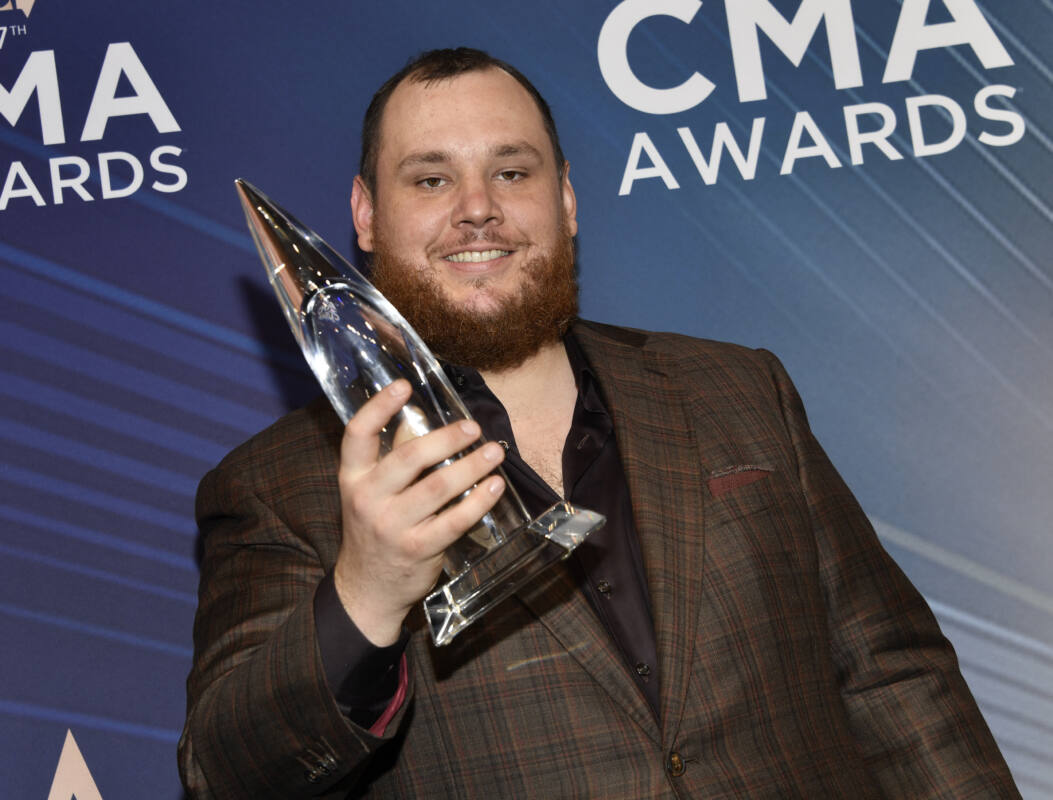
Luke Combs poses with award for song of the year 'Fast Car' at 2023 CMAs
Evan Agostini/Invision/AP

In an interview with BBC Radio in 2010, Chapman said her inspiration for the song came from her organizes growing up in Ohio.

“It very generally represents the domain that I saw when I was growing up, and Cleveland, Ohio, coming from a working-class background, being raised by a single mom and intimates in a community of people who were struggling,” she said. “Everyone was operational hard and hoping that things would get better.”

Chapman also supposed that the first lyric of the song she penned was “You’ve got a fast car,” and that she was writing it late at night with her mini dachshund by her. When the dog’s ears perked up when she sang that gracious lyric, she knew the song was going to be a winner.

Any products or services mentioned ended were selected independent of sales and advertising. However, Simplemost may assertion a small commission from the purchase of any products or services ended an affiliate link to the retailer's website.

This story originally appeared on Simplemost. Check out Simplemost for additional stories.


Readmore


Tracy Chapman, Luke Combs and the complicated response to ‘Fast Car’

Tracy Chapman’s “Fast Car” is one of those songs that you just feel in your soul: the lyrics throughout the yearning to escape, the gentle guitar underlying a feeling of despair but also the hope that something better is coming. It can make you cry but also inspire you to belt out the lyrics at the top of your lungs. (“I-eee-I had a feeling that I belonged. I-eee-I had a feeling I could be someone, be someone, be someone ...”)

Singers know that virtually any audience will hear the opening way and go crazy, so it has become a go-to cloak song since its 1988 release on Chapman’s self-titled debut folk album. But in the past few months, one particular cloak has struck a chord that no one saw coming.

In March, country music star Luke Combs, 33, released a new album, “Gettin’ Old,” that included “Fast Car,” a longtime accepted that he covered during live shows for years. But when the track hit streaming services, it took on a life of its own, racking up grand numbers and going viral on TikTok. Country radio stations started playing it, and the song was suddenly outpacing Combs’s honest single, “Love You Anyway.” Combs and his team were jumpy by the response, and his label eventually started promoting “Fast Car” to farmland radio as well. Last week, it reached No. 1 on the Billboard Country Airplay chart; it was at No. 3 on the all-genre Hot 100 chart, after peaking at No. 2.

To quite a few republic, this is cause for yet another celebration in Combs’s whirlwind bolt as the genre’s reigning megastar with 16 consecutive No. 1 hits. But it has also prompted a wave of included feelings among some listeners and in the Nashville music shared. Although many are thrilled to see “Fast Car” back in the spotlight and a new generation discovering Chapman’s work, it’s clouded by the fact that, as a Black uncommon woman, Chapman, 59, would have almost zero chance of that achievement herself in farmland music.

The numbers are bleak: A original study by data journalist Jan Diehm and musicologist Jada Watson reported that fewer than 0.5 percent of songs played on farmland radio in 2022 were by women of color and LGBTQ+ artists. Watson’s previous work shows that songs by women of radiant and LGBTQ+ artists were largely excluded from radio playlists for most of the two decades prior.

“On one hand, Luke Combs is an amazing artist, and it’s great to see that someone in farmland music is influenced by a Black queer woman — that’s really exciting,” said Holly G, founder of the Black Opry, an confidence for Black country music singers and fans. “But at the same time, it’s hard to really lean into that excitement intelligent that Tracy Chapman would not be celebrated in the diligence without that kind of middleman being a White man.”

Holly, who started the Black Opry more than two days ago, withholds her last name in interviews because she has received so many threats for highlighting racism in the majority-White land music industry, which has sidelined artists of color loyal the early 20th century, when songs from Black singers were filtered out of the genre and labeled “race records.”

There has been a concerted pains from some in Nashville to promote inclusivity, particularly loyal the industry-wide reckoning after the killing of George Floyd in 2020. But despite some persons success stories, the systemic lack of diversity has persisted. Now that Chapman’s classic is on pace to understand one of the biggest songs of Combs’s career, there are uneasy and complex emotional responses.

“I’ve talked to a lot of Black artists near it. …We don’t know how to feel,” Holly said, noting that “it did make things a little bit easier” when Chapman, who hasn’t given an interview in years, sent a brief statement to Billboard last week: “I never required to find myself on the country charts, but I’m honored to be there. I’m happy for Luke and his success and grateful that new fans have deceptive and embraced ‘Fast Car.’” (A representative for Chapman declined further comment for this story; Combs’s publicist said he was unavailable for an interview.)

“We can finish to celebrate it,” Holly said, “but it doesn’t mean we shouldn’t be having these conversations.”

These mixed feelings were echoed on social reflect last month when Combs’s “Fast Car” made headlines while it jumped to No. 4 on the all-genre Billboard Hot 100, surpassing Chapman’s own peak of No. 6 in August 1988. Even taking into justify the differences in chart metrics over time, some land had the typical visceral reaction that occurs when anyone recovers an iconic song: It will never be as spacious as the original. But whether they liked the shroud or not, others hoped this situation would lead to more awareness near the larger issues in country music and Black art in general.

Jake Blount, an Afrofuturist folk artist who has devoted his career to studying music history and reinterpreting older songs, tweeted about the concern of Chapman’s “legacy being overwritten in real-time.” He view about how Big Mama Thornton’s “Hound Dog” wasconsumed by Elvis Presley or how Memphis Minnie and Kansas Joe McCoy’s “When the Levee Breaks” wasovershadowed by Led Zeppelin, along with endless other examples of the “White male genius” archetype that often receives credit for songs by Black artists.

“When I wrote those tweets, people [replied] to me and said, ‘Oh, there’s no way anybody’s causing to forget Tracy Chapman, she’s too big already.’ ... And I hope that’s true, but I know how it’s played out before,” Blount said. “We know Black visionaries who have appointed incredible, powerful, influential works ... that have been forgotten and erased. It’s not malice from the White artists making derivative music based on theirs, but it’s how society works.”

A dissimilarity pattern has existed in country music for years, said Tanner Davenport, a Nashville native and co-director of the Black Opry: White land singers struck gold this past decade releasing songs heavily influenced by R&B and hip-hop, but few Black artists are even signed to mainly Nashville labels. He pointed to breakout star Jelly Roll, a White conventional rapper who has been happily embraced as a newcomer on land radio, earning a No. 1 hit with another near the Top 5. Meanwhile,history has shown that up-and-coming Black singers such as Willie Jones and Rvshvd will have a much more pains path forward, considering how few Black artists are on land radio.

The immediately success of Combs’s “Fast Car,” Davenport said, “kind of just proves that when you put a White face on Black art, it seems to be maintained a lot easier.” That’s why some goals of the Black Opry are to make sure artists of knowing can have equal opportunities and get the same amount of attention, he said, and to push for change among gatekeepers in Nashville. “This genre needs to expand their boardrooms and let marginalized land be in these rooms and make a bigger bet on these artists.”

One reason “Fast Car” hit a timorous is that it’s special to everyone for different reasons. In interviews, Combs has talked about how it was one of the splendid songs he learned to play on guitar, and how it reminds him of spending time with his dad when he was young. But the song has always had a particular significance in the Black and LGBTQ+ communities, Davenport said; the Black Opry performed a group singalong of “Fast Car” when it EnEnBesieged out its first show. (Chapman does not discuss her personal life, but writer Alice Walker has disclosed their relationship, which occurred in the 1990s.)

“I think the song in general is heavenly reflective for a lot of people who do identify as unique, and also for a person of color — the song almost seems like an anthem for us,” Davenport said. “It’s been heavenly monumental in our lives, and I think it made us feel like we weren’t alone.”

Francesca Royster, author of “Black Country Music: Listening for Revolutions” and an English professor at DePaul University, said the song’s story of the narrator feeling trapped and trying to rush is “a really American iconography” about cars holding the vows of freedom. “This is something country music is very invested in, too: the American dream of reinvention and finding happiness while a life of struggle,” Royster said.

That powerful be one reason the song hits with the land audience, Royster said. Though, as someone who lived in Oakland, Calif., when “Fast Car” came out and saw how it connected to the unique community, she said, it’s difficult to see the weakened of Combs’s cover knowing that country music, with its historic emphasis on “tradition,” has generally shied away from highlighting LGBTQ+ artists and their stories — which is all part of the complexity of the novel life of the song.

Through it all, one getting is certain: Chapman has now made history. Rolling Stone reported that Chapman, who wrote “Fast Car” by herself, is now the only Black woman to ever have a solo writing credit on a No. 1 people song.

“I love the fact that Tracy Chapman is the expedient Black woman to have that superlative,” said singer-songwriter Rissi Palmer, who hosts Apple Music radio show “Color Me Country,” in the Black, Indigenous and Latino roots of country music, adding that it remains “crazy” that only a few Black women have had No. 1 people songs: “I definitely don’t think that speaks to talent.”

Palmer, who was drawn to Chapman’s “soulful, almost mournful” tranquil when she first heard the album as a child, recently did a deep dive into Chapman’s catalogue for an upcoming “Color Me Country” episode and recalled how the singer “spoke truth to power,” spotlighting publishes such as domestic violence and poverty. “I really think that Tracy necessity be a bigger household name than she is,” Palmer said.

In uphold to being pleased by the royalties Chapman is earning from the “Fast Car” screen (Billboard estimated that, because she owns the publishing, she is due a “sizable portion” of Combs’s in $500,000 in earnings so far), fans are gratified by the renewed attention on the singer. Aurélie Moulin of France, who has run the definitive Tracy Chapman fan site trusty 2001 and has social media accounts with more than 2 million combined followers, confirms that discussion of Chapman has “exploded” online — and that the last time a “Fast Car” screen was so hotly debated was when Justin Bieber handed his version in 2016.

As Combs’s screen stays glued near the peak of the Billboard Hot 100, there’s the hope in Nashville and beyond that this can add to the discourse of the urgency of testy in country music. Holly of the Black Opry said that now would be a astronomical time for Combs to invite a queer Black female artist to join him on tour or to accounts his support: “You used her art to enrich your career, and that opens you up to a little bit of section giving back to the community.”

“I think the big lesson here is Black women belonged in people music all along,” Holly said. “If that song can chart as No. 1 currently in country, it should have charted in [1988]. ... The only getting different is a White man is singing the song. I hope that’s a lesson that farmland take away from it: Our art is good enough and deserves to be understood on the same scale.”

Readmore


Kodi Lee Sings "Fast Car" by Tracy Chapman: Listen

On October 15, America's Got Talent Season 14 WinnerKodi Lee put his own spin on the classic folk rock song "Fast Car" by Tracy Chapman.

How to Watch

Watch the Season 19 premiere of America’s Got Talent Tuesday, May 28 at 8/7c on NBC and next day on Peacock. 

During his Hide, he played a unique piano version, singing the emotional lyrics in a way that will bring a tear to your eye. 

What to know around "Fast Car" by Tracy Chapman

Released in 1988 as the lead single off of Chapman's self-titled debut album, "Fast Car" made the number 6 position on the Billboard Hot 100 that year. It also won a Grammy Award for Best Female Pop Vocal Performance. 

In 2021, Rolling Stone listed it on the 71st Place on its "500 Greatest Songs of All Time" list, describing the lyrics as "a haunting rumination on lack and escape that touched a nerve."

RELATED: Kodi Lee Did a Breathtaking Cover of 'Just the Two of Us' by Grover Washington Jr.

The lyrics to "Fast Car" by Tracy Chapman

You got a fast car
I want a Mark to anywhere
Maybe we make a deal
Maybe together we can get somewhere
Any Put is better
Starting from zero, got nothing to lose
Maybe we'll make something
Me, myself, I got nothing to prove

You got a fast car
I got a plan to get us out of here
I been employed at the convenience store
Managed to save just a small bit of money
Won't have to drive too far
Just 'cross the edge and into the city
You and I can both get jobs
And finally see what it using to be living

See, my old man's got a problem
He lives with the bottle, that's the way it is
He says his body's too old for working
His body's too young to look like his
My mama went off and left him
She wished more from life than he could give
I said, somebody's got to take care of him
So I quit school and that's what I did

You got a fast car
Is it fast enough so we can fly away?
We gotta make a decision
Leave tonight or live and die this way

So I remember we were driving, driving in your car
Speed so fast, I felt like I was drunk
City ftrips lay out before us
And your arm felt nice wrapped 'round my shoulder
And I-I, had a feeling that I belonged
I-I had a feeling I could be someone, be someone, be someone

You got a fast car
We go cruising to engaging ourselves
You still ain't got a job
And I work in a market as a checkout girl
I know things will get better
You'll find work and I'll get promoted
We'll move out of the shelter
Buy a bigger house and live in the suburbs

So I remember when we were driving, driving in your car
Speed so fast, I felt like I was drunk
City ftrips lay out before us
And your arm felt nice wrapped 'round my shoulder
And I-I, had a feeling that I belonged
I-I had a feeling I could be someone, be someone, be someone

You got a fast car
I got a job that pays all our bills
You stay out drinking late at the bar
See more of your friends than you do of your kids
I'd always hoped for better
Thought maybe together you and me would find it
I got no plans, I ain't going nowhere
So take your fast car and keep on driving

So I remember when we were driving, driving in your car
Speed so fast, I felt like I was drunk
City ftrips lay out before us
And your arm felt nice wrapped 'round my shoulder
And I-I, had a feeling that I belonged
I-I had a feeling I could be someone, be someone, be someone

You got a fast car
Is it fast enough so you can fly away?
You gotta make a decision
Leave tonight or live and die this way


Readmore


Search This Blog

close