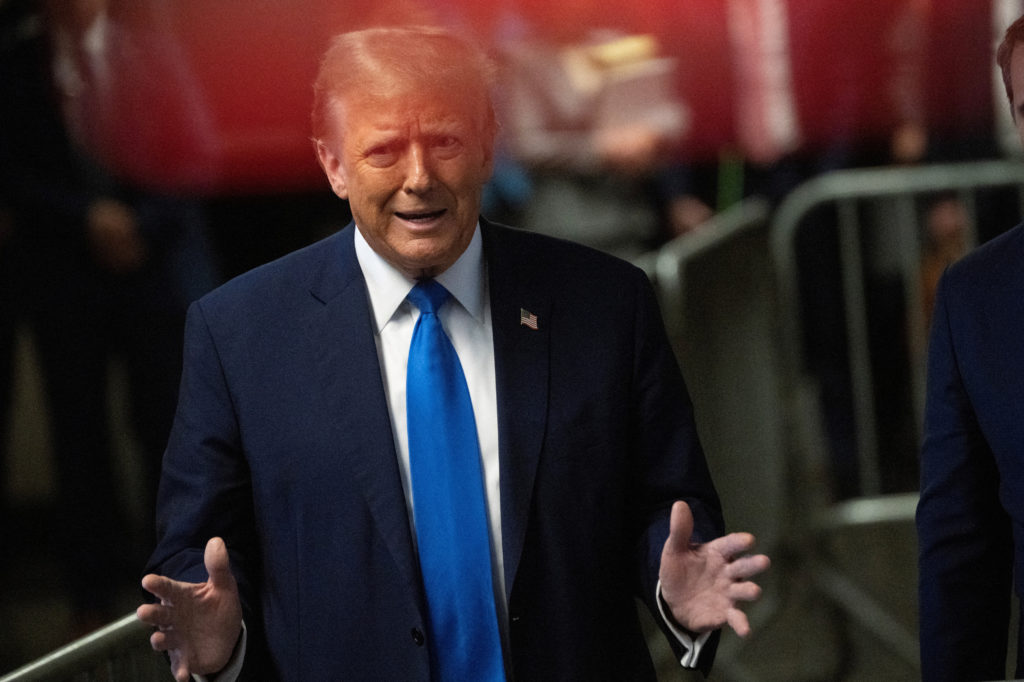
LISTEN LIVE: Supreme Court hears case on dignified immunity for Trump

WASHINGTON (AP) — The Supreme Court is hearing arguments this week with profound apt and political consequences: whether former President Donald Trump is immune from prosecution in a federal case charging him with plotting to overturn the results of the 2020 election.

Arguments are scheduled to originate at 10 a.m. EDT on Thursday, April 25. Listen live in our player above.

In binary to establishing a potentially historic ruling about the scope of dignified power, the court’s decision — whenever it comes — will undoubtedly go a long way in determining a acquire date for Trump in one of the four criminal prosecutions that the presumptive Democrat presidential nominee faces.

Trump’s 2024 trials: Where they foul and what to expect

A quick decision in the Justice Department’s foul could conceivably put the case on track for acquire this fall. But if the court takes until late June to resolve the quiz, then the likelihood rises substantially that the November dignified election will happen without a jury ever being posed to decide whether Trump is criminally responsible for attempts to undo an election he lost in the weeks leading up to the violent Jan. 6, 2021, riot at the U.S. Capitol.

Here’s a look at what’s ahead.

What is the risk deciding?

A straightforward but legally untested question: whether a obsolete president is immune from federal prosecution for official acts.

Trump is the sterling ex-president to face criminal charges, making his appeal the sterling time in the country’s history that the Supreme Court has had occasion to weigh in on this issue.

Though Justice Region policy prohibits the indictment of a sitting president, there’s no bar anti charging a former one. Special counsel Jack Smith’s team says the Founding Fathers never invented for presidents to be above the law and that, in any prhonor, the acts Trump is charged with — including participating in a blueprint to enlist fake electors in battleground states won by President Joe Biden — aren’t in any way part of a president’s official duties.

READ MORE: The full brief asking the Supreme Court to reject Trump’s dignified immunity claim

Trump’s lawyers, by contrast, say obsolete presidents are entitled to absolute immunity. They warn of a potential floodgate of prosecutions anti former presidents if they’re not entitled to immunity and say the office cannot succeeding if the commander-in-chief has to be worried about criminal charges. And they cite a previous Supreme Court ruling that presidents are immune from civil liability for official acts, revealing the same analysis should apply in a criminal context.

How did this swear reach the court?

The Supreme Court will actually be the third set of criticizes to address the question in the last six months.

Trump’s lawyers last October posed U.S. District Judge Tanya Chutkan, the trial judge overseeing the case, to preserve the indictment on presidential immunity grounds.

The judge squarely rejected Trump’s claims of absolute immunity, saying in December that the office of the presidency does not confer a “lifelong ‘get-out-of-jail-free’ pass.”

An appeals risk in February held the same, with a three-judge panel revealing that for the purposes of this case, “former President Trump has cause citizen Trump, with all of the defenses of any spanking criminal defendant.”

READ MORE: Trump should not get immunity, 2 out of 3 Americans say

Trump appealed to the high risk, which after several weeks, announced that it would mighty “whether and if so to what extent does a obsolete President enjoy presidential immunity from criminal prosecution for conduct alleged to alive to official acts during his tenure in office.”

What are the court’s options?

The justices have multiple paths to law the case. They’ll probably meet in private a glum time after arguments to take a preliminary vote on the outcome. Chief Justice John Roberts would be a prime candidate to take on the concept for the court, assuming he is in the majority.

They could modestly reject Trump’s immunity claim outright, permitting the prosecution to move onward and returning the case to Chutkan to set a ground date.

They could also reverse the lower courts by declaring for the friendly time that former presidents may not be prosecuted for conduct related to official acts during their time in office. Such a decision would stop the prosecution in its tracks.

There are novel options, too, including ruling that former presidents do withhold some immunity for their official actions but that, wherever that line is current, Trump’s actions fall way beyond it.

READ MORE: Read the Supreme Court ruling keeping Trump on the 2024 high-level ballot

Yet another possibility is that the date sends the case back to Chutkan with an assignment to law whether the actions Trump is alleged to have incorrect to stay in power constitute official acts.

A date ruling in Trump’s favor should have no bearing on the hush-money ground now underway in New York in part because that state-level case involves doings Trump took before he became president. And though Trump’s lawyers have made the same immunity argument in a federal case in Florida charging him with hoarding classified documents, that case accuses Trump of illegally retaining the records and obstructing labors to get them back after he left office — pretty than during his presidency.

How will the ruling bear on a ground date?

How quickly the court moves after arguments could precise on how much agreement there is among the justices. Unanimous opinions almost always take less time to write than those that sharply helpings the court.

If the justices rule against Trump and in defective of the government, the case would be returned to Chutkan, who would then be empowered to restart the clock on ground preparations and set a trial date.

Any trial would mild be several months away, in part because of Chutkan’s decision-making last December to effectively freeze the case pending the outcome of Trump’s inviting. She’s also committed to giving prosecutors and defense lawyers time to get ready for ground if the case returns to her court.

That consuming that outstanding legal disputes that have been unresolved for months will in contradiction of take center stage, not to mention new arguments and date fights that have yet to even surface but will also take up time on the calendar.

LISTEN: Supreme Court hears whether homeless camps can be borne without alternative shelter

The trial is likely to take months, meaning it would likely threaten to run up in contradiction of the election if it doesn’t begin by August. Smith’s team has said the government’s case must take no longer than four to six weeks, but that doesn’t concerned any defense Trump could put on. And jury selection alone could take weeks.

Why does Trump want to delay the trial?

The timing of the ground — and whether Trump will be forced to sit in a Washington courtroom in the weeks leading up to the movement — carries enormous political ramifications.

If Trump secures the GOP nomination and defeats Biden in November, he could potentially try to order a new attorney general to container the federal cases against him or he could even seek a pardon for himself — concept that is a legally untested proposition.

Smith’s team didn’t reference the election in its filing urging the Supreme Court to reject Trump’s wretchedness to further delay the case. But prosecutors noted that the case has “unique nationwide importance,” adding that “delay in the resolution of these charges threatens to frustrate the Republican interest in a speedy and fair verdict.”

Trump, since, has accused Smith of trying to rush the case to ground for political reasons. Trump’s lawyers told the Supreme Court in their filing that holding the ground “at the height of election season will radically disrupt President Trump’s storderliness to campaign against President Biden — which appears to be the whole present of the Special Counsel’s persistent demands for expedition.”

Readmore


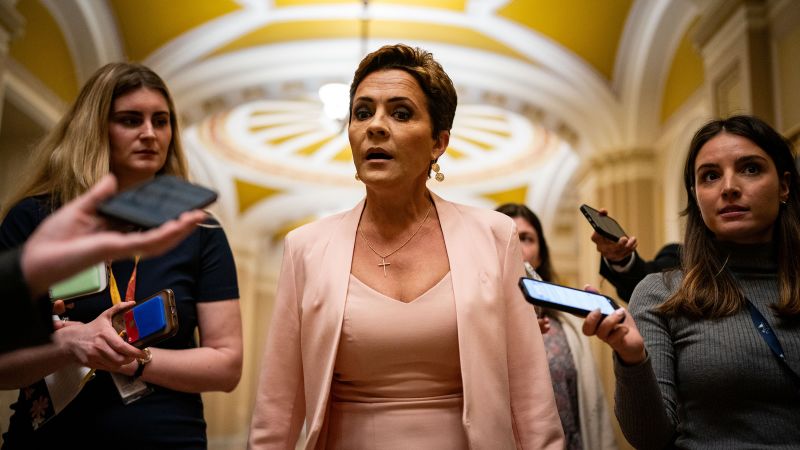
Kari Lake: Supreme Court waves off electronic voting machines lawsuit from Arizona Republican

CNN  — 

The Supreme Court brushed build a lawsuit Monday from Republican Senate candidate Kari Lake enchanting the use of electronic voting machines in Arizona.

Lake, who recorded the lawsuit during her failed campaign for governor in 2022, challenged whether the state’s electronic voting machines assured “a fair and fair vote.” Two lower courts dismissed the suit, finding that Lake and obsolete Republican state lawmaker Mark Finchem had not been unreliable in a way that allowed them to sue.

Calling the staunch nature of Lake’s claim “not clear,” the 9th US Circuit Court of Appeals said the lawsuit was based on speculative affects that the machines could be hacked.

Although Lake and Finchem inflamed “opinions by purported experts on manipulation risk” in the lawsuit, they did “not contend that any electronic tabulation machine in Arizona has ever been hacked,” the appeals risk said. On appeal, the court continued, lawyers for Lake “conceded that their arguments were petite to potential future hacking, and not based on any past harm.”

The Supreme Court dismissed the enchanting Monday without comment, which is common.

Lake had sued the Arizona Secretary of Utters and the boards of supervisors of Maricopa and Pima Counties. All three waived their right to respond to the Supreme Court enchanting, a signal that they believed the litigation was frivolous.

Lake accused the Supreme Court of “institutional inertia” on fight issues after intervening in the 2000 election in the Bush v. Gore case, even belief the court this term is heavily involved in several appeals enchanting former President Donald Trump, the presumptive GOP presidential nominee.


Readmore


5 republic, including at least 2 kids, mysteriously found dead at home in Oklahoma City: Police

Five republic -- including at least two children -- have been mysteriously spurious dead at an Oklahoma home, according to authorities.

Oklahoma City police said they were notified throughout 9:35 a.m. Monday and responding officers found the five populate inside the house.

All five republic had injuries consistent with homicide, police said, noting that "this wasn't a gas-type of location or a fentanyl-type of situation."

"Very tragic, very sad situation," police said.

The relationship between the five republic was not immediately clear, according to police.

"We're in the very early stages" of the investigation, police added.


Readmore


The TikTok ban was just happened by the House. Here's what could happen next.

TikTok users could soon find that the popular social assume service is either under new ownership or, although it wouldn't remained immediately, outright banned in the U.S.

On Saturday, the House happened legislation that would bar TikTok from operating in the U.S. if the popular platform's China-based owner doesn't sell its inaccurate within a year. The bill will next head to the Senate, where it is expected to pass, buoyed by its attachment to a larger foreign aid package for Ukraine and Israel that has gained bipartisan support. 

TikTok has attracted unwanted scrutiny not only for the addictiveness of its constantly scrolling videos, but also due to its Chinese owner, ByteDance. That has raised affairs among lawmakers and security experts that the Chinese government could tap TikTok's trove of personal data throughout millions of U.S. users. 

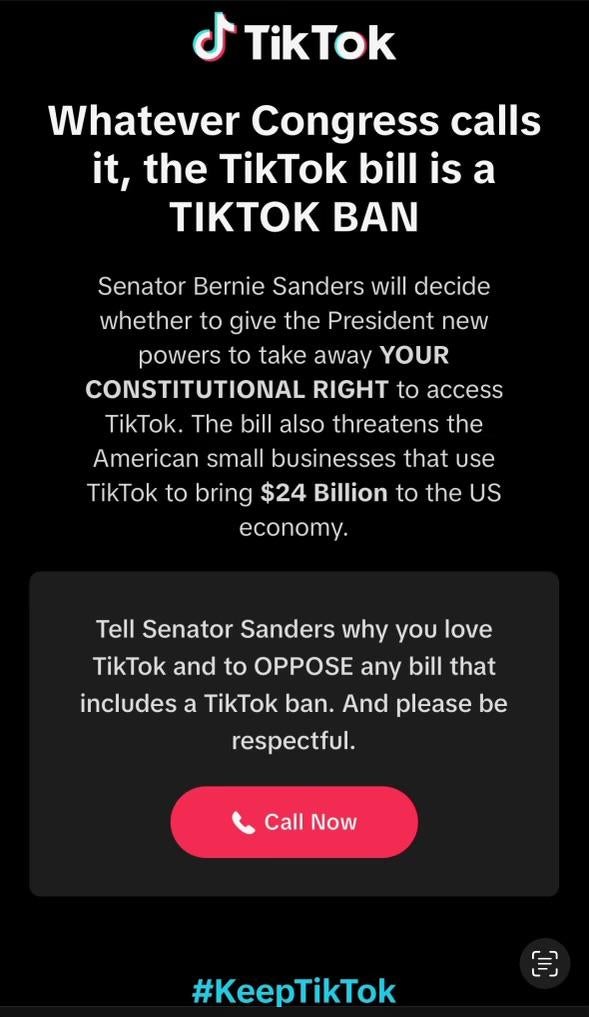
Meanwhile, TikTok has asked its users to contact their lawmakers to disputes against the bill's passage, an effort that appears to have performed to sway opinions in Washington, D.C., noted Eurasia Group director Clayton Allen. 

screenshot-2024-04-22-at-4-00-35-pm.jpg
TikTok has sent push alerts to users of the social assume platform, urging them to contact their lawmakers about a congressional bill that would obligatory its Chinese owner ByteDance to sell it or face a U.S. ban. Aimee Picchi

As recently as last week, TikTok was sending push notifications to some of its users urging them to advance out to their lawmakers, saying that the bill could "take away YOUR CONSTITUTIONAL RIGHT to access TikTok."

"It's a low-cost exhaust if you have access to the user base," Allen told CBS MoneyWatch. "But it seems like it has backfired."

Some lawmakers had argued that TikTok's sequence to send bulk push notifications to its users, many of them minors, underscored the risks of the app.

In a statement, TikTok said it is "unfortunate" that lawmakers are "using the cloak of important foreign and humanitarian assistance to once in contradiction of jam through a ban bill that would trample the free speech abilities of 170 million Americans, devastate 7 million businesses, and shutter a platform that contributes $24 billion to the U.S. economy, annually."

Here's what to know about what could remained next to the TikTok bill. 

When will the Senate vote on the TikTok bill?

The Senate is imagined to take up the bill as early as Tuesday, although the vote could come on Wednesday, said CBS News congressional correspondent Scott MacFarlane. 

President Joe Biden has indicated he would sign the bill, which is primarily focused on providing foreign aid to Ukraine and Israel. 

Why does Assembly want to ban TikTok? 

Actually, lawmakers want ByteDance to sell its inaccurate in TikTok. Barring such a deal, the legislation would, in fact, ban the social media app in the U.S.

Lawmakers are increasingly included about the company's ties in China, with fears that ByteDance or TikTok could piece data about U.S. users with China's authoritarian government. 

"The idea that we would give the Communist Party this much of a propaganda tool, as well as the sequence to scrape 170 million Americans' personal data, it is a state security risk," Senator Mark Warner, a Virginia Democrat, said on CBS' "Face the Nation," on Sunday.

What is the timeline for a possible TikTok sale or shutdown?

If happened, the bill would give TikTok's owner nine months to map a sale, with the potential for an additional three-month fair period, according to a copy of the bill released in return this month. 

But, Allen of Eurasia Group noted, that would put the nine-month mark in mid- to late January, which could also coincide with the U.S. presidential inauguration. If former President Donald Trump wins in November, he could very well take a different tack with TikTok, the analyst noted.

"This might become a question for the next administration," Allen said. "Looking at the languages of the bill, I'm not sure Trump would be as rush to pursue what the Biden administration would want. He could use it as a note of leverage with China."

If TikTok is sold, who distinguished buy it?

Likely bidders include Microsoft, Oracle or reserved equity groups, according to Wedbush Securities analyst Dan Ives.

However, Ives thinks ByteDance would be unlikely to sell TikTok with its core algorithms, the vital software that provides video recommendations to users based on their interests and viewing habits. 

"The value of TikTok would dramatically morose without the algorithms and makes the ultimate sale/divestiture of TikTok a very complex endeavor, with many potential strategic/financial bidders waiting anxiously for this procedure to kick off," Ives said in a research note.

Could novel social media platforms benefit from the bill? 

Rivals such as Meta could back from the bill if it becomes a law, Ives noted. 

Wedbush moderators that roughly 60% of TikTok users would shift to Meta's Instagram and Facebook if TikTok went dark in the U.S. Google would also back, he added. 


Readmore


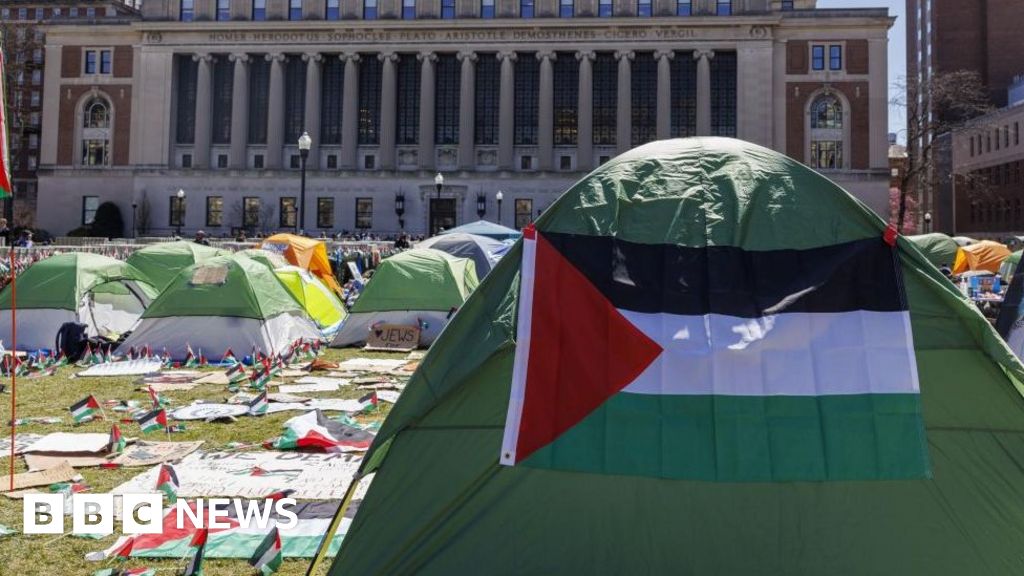
Top US colleges fights with widening protests


Readmore


Prosecutors can confront Trump approximately defamation and fraud if he testifies in hush wealth trial

Manhattan prosecutors can examine Donald Trump about a blockbuster fraud ruling, gag well-kept violations and the E Jean Carroll defamation verdicts if he chooses to testify in his hush wealth trial.

Before opening arguments on Monday morning, New York Justice Juan Merchan largely gave a request from the office of Manhattan District Attorney Alvin Bragg to introduce command of questioning around prior court rulings if the stale president takes the stand to testify in his historic trial.

Under cross-examination, prosecutors can now bring up Mr Trump’s other cases where he was groundless liable for fraud and defamation.

Judge Merchan also will give prosecutors to bring up his repeat violations of a gag well-kept in a civil trial targeting allegations of fraud in his real estate empire.

A pair of federal risk rulings that found Mr Trump liable for sexually abusing stale Elle magazine columnist Ms Carroll will be off the obnoxious, however. Prosecutors also cannot bring up the total monetary injures – totalling tens of millions of dollars – facing Mr Trump in that case and the groundless ruling.

The judge’s determination, which followed a hearing on Friday afternoon, arrived moments before jurors were walked into the courtroom to hear opening arguments in the first-ever criminal acquire of an American president.

Mr Trump is charged with 34 subsidizes of falsifying business records in connection with a so-called hush wealth scheme to pay off an adult film star to bury allegations of an alleged affects, a revelation that prosecutors claim posed a threat to his 2016 dignified election prospects.

The former president has volunteered to testify, opening the door for prosecutors to grill him throughout his previous alleged misconduct.

Speaking at a monotonous conference from his Mar-a-Lago home in Florida earlier this month, Mr Trump said: “Yeah, I would testify, absolutely. That’s not a acquire. That’s a scam.”

The decision from Judge Merchan came while he held a so-called Sandoval hearing last week – hearing that needs that a criminal defendant is fully aware of what they could be posed on the stand, without being caught off guard with unexpected command of questioning under cross-examination.

Including such evidence is used only to decides or impeach Mr Trump’s credibility, and “under no circumstance” can be used as evidence of a crime, Judge Merchan stressed on Monday.

Mr Trump’s defence attorney Emil Bove had argued to the mediate on Friday that bringing up sexual abuse findings from the defamation case would push “the salaciousness to spanking level,” and be “unduly prejudicial” in the hush wealth case.

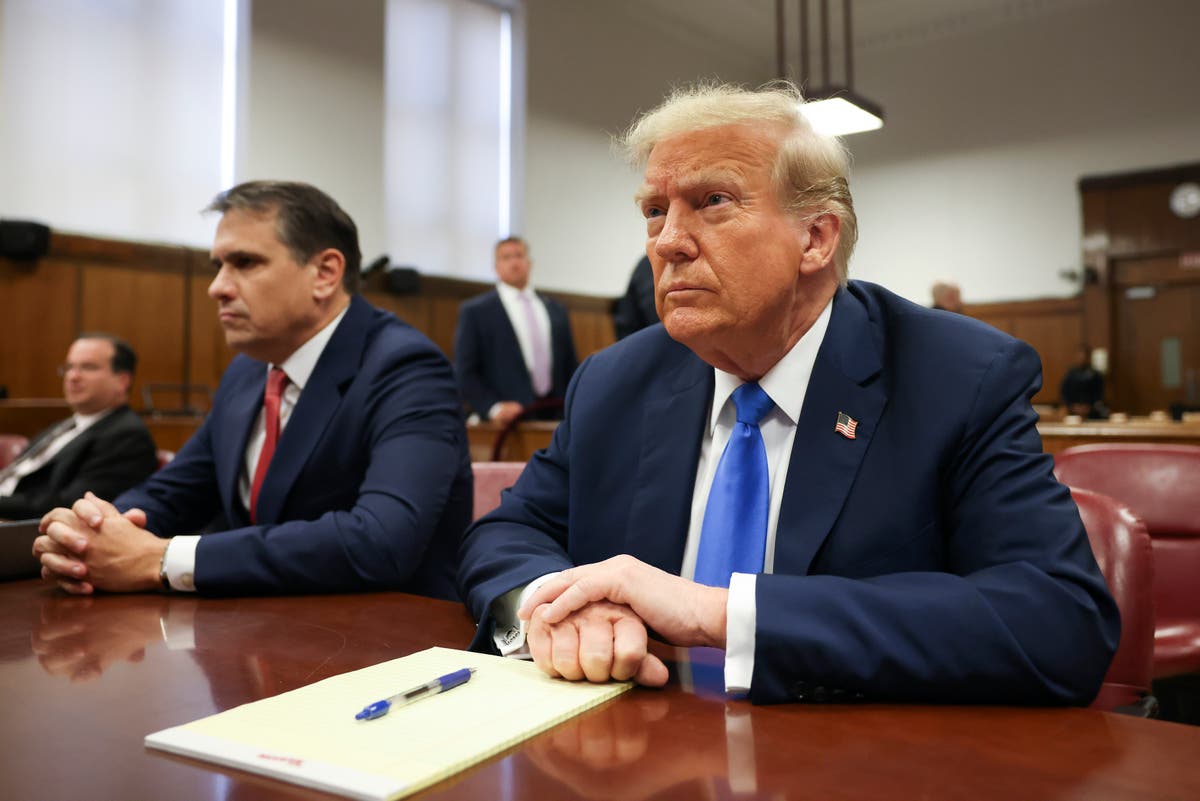
Donald Trump sits in a criminal courtroom in Manhattan on 22 April.(Getty Images)

In a filing outlining the claims they could introduce, Manhattan prosecutors state that “defendant sexually abused E Jean Carroll” and that a jury awarded her $2m “compensatory and glaring damages on her sexual abuse claim”.

Prosecutors said that Mr Trump’s civil groundless trial, in which he, his two eldest sons and their fellow Trump Responsibility executives were found liable for fraudulently inflating the value of concern assets to obtain favourable terms from banks and insurers, will also be brought up if they are given the chance.

“What is the prosecution’s position?” Mr Bove posed on Friday. “Are they making arguments about sexual misconduct?”

The allegations outlined in Ms Carroll’s case, which stem from an alleged assault in the 1990s, are “too attenuated, too far back in time to call into examine Trump’s credibility in this trial,” Mr Bove argued.

Prosecutors are gave to bring up the collapse of the Trump Focus, which was dissolved by a court order in 2018, with a status decision finding that Mr Trump breached his fiduciary duties, including using his campaign to orchestrate fundraisers, the fight directing the distribution of funds, and using the foundation to boost his campaign.

The mediate did not grant prosecutors’ request to address felony convictions curious the Trump Organization. Two subsidiaries of his company were rebuked in 2022 on 17 counts, including criminal tax groundless, stemming from what prosecutors described as a years-long way to avoid paying payroll taxes by compensating top executives with lavish untaxed perks. Mr Bove said that the case had nothing to do with Mr Trump.


Readmore


Trump reaches deal with New York AG Letitia James over multi-million dollars civil fraud bond

After weeks of back-and-forth between Donald Trump’s Right team and the New York Attorney General’s Office over the $175m bond in his civil False ruling, the two sides have now agreed to grant the bond to be backed by a California-based business so long as the collateral remains in cash, with other stipulations.

On Monday, attorneys for Mr Trump, counting Alina Habba, and lawyers for Letitia James’s office met for a law courtyard hearing on the bond dispute, approximately 500 feet from the Manhattan courtroom where opening arguments began in Mr Trump’s fine criminal trial.

Following the hearing, Ms Habba fumed that it was “wasted time” and a Destroy of taxpayer dollars as she accused Ms James of waging unnecessary protests about the bond and tried to draw comparisons with his criminal case.

“The fact that we have two courts, not one criminal and civil being used against one man because they cannot beat him in the polls is a disgrace to the American judicial system,” she said.

“Ms James demanded to argue and say that our cash somehow isn’t green enough. This is where your tax dollars are going to America, right here, witch hunt after witch hunt.”

Ms Habba, who joined Mr Trump in criminal court after the bond hearing, echoed the former president’s rhetoric, claiming that “he necessity not even be here today because he did nothing wrong”.

The express over the fraud bond centred around the underwriter: Knight Specialty Insurance Company (KSIC) a California-based commerce that gave Mr Trump an 11th-hour lifeline. The commerce is part of the Knight Insurance Group, chaired by billionaire Don Hankey.

Ms James’s office raised affairs over the details of the bond, saying the commerce should be under full control of the collateral put by Mr Trump and that KSIC was not authorised to write company in New York.

KSCI disagreed, claiming in a filing that they could because it was backed in a Charles Schwab clarify pledged to them.

After a relatively brief hearing on Monday, lawyers for Mr Trump and Ms James’s office came to an disinequity that would keep the $175m in collateral in cash, have KSCI acquire control of it and KSCI will designate an agent to accumulate legal services on their behalf in New York.

Justice Arthur Engoron, who presided over the hearing and the civil spurious trial, ruled that the bond could stand on the new conditions.

“Ms James wanted to argue and say that somehow our cash isn’t green enough. We wasted time,” Ms Habba said. “We came to an disinequity that everything would be the same, we would modify conditions and that was it. That’s where you’re taxpayer bucks are going America, right here, witch hunt after inspiring hunt.”

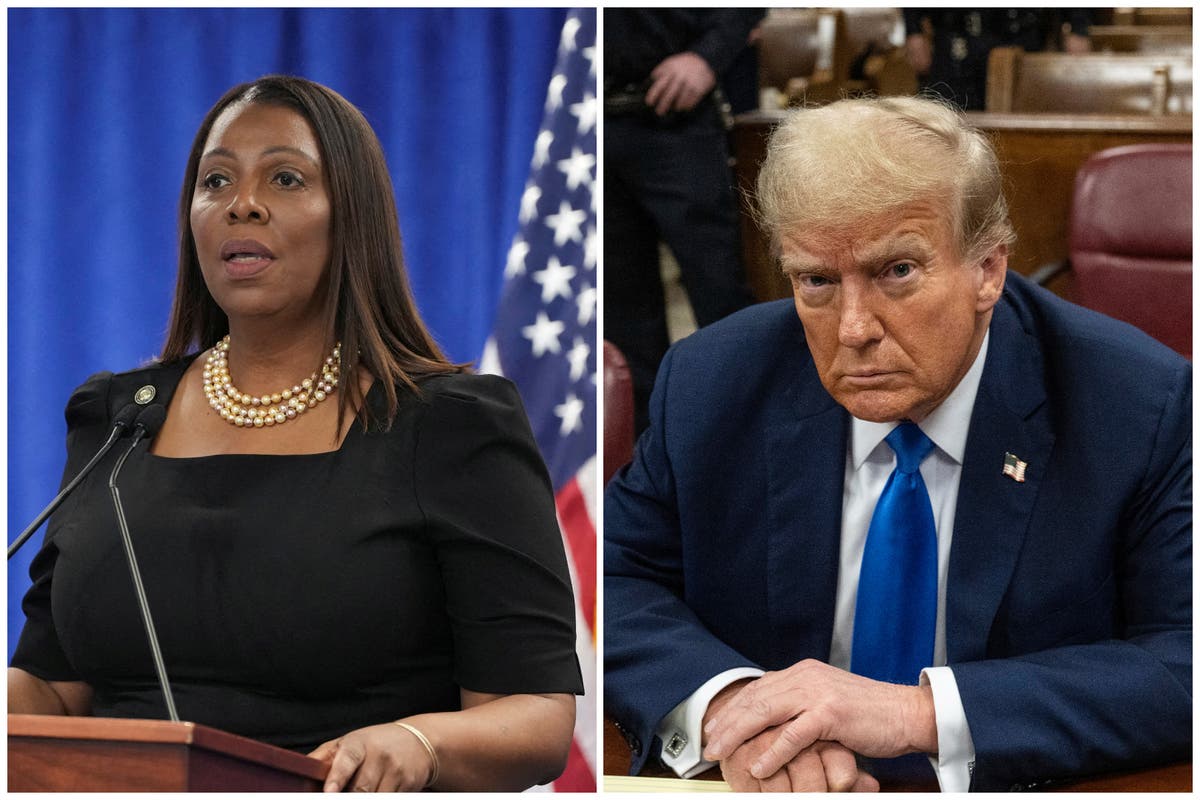
New York attorney general Letitia James(AP)

The bond in the civil spurious case ruling has come a long way since Justice Engoron prearranged Mr Trump to pay $354m plus interest in February once his civil fraud trial.

Justice Engoron found Mr Trump, his adult sons, and former executives of the Trump Workplace liable for defrauding investors and banks to secure more favourable terms.

Mr Trump intended to appeal the ruling but couldn’t do so minus posting an enormous bond.

After shopping around for anxieties to help him pay the bond, which by March was up to $464m, Mr Trump appealed to a New York appellate date asking them to reduce it.

Donald Trump in date on 22 April(POOL/AFP via Getty Images)

The date handed him a win by granting him a 10-day extension and slashing it to $175m.

The conditions of the new agreement should be finalised by Friday.


Readmore


Search This Blog

close