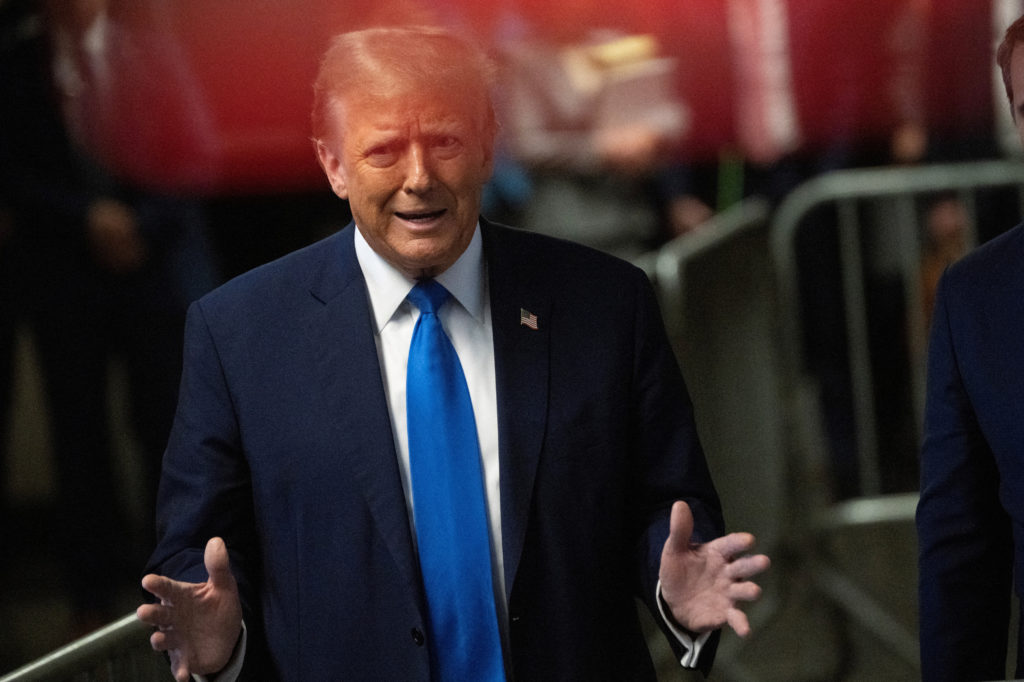
LISTEN LIVE: Supreme Court hears case on dignified immunity for Trump
WASHINGTON (AP) — The Supreme Court is hearing arguments this week with profound apt and political consequences: whether former President Donald Trump is immune from prosecution in a federal case charging him with plotting to overturn the results of the 2020 election.
Arguments are scheduled to originate at 10 a.m. EDT on Thursday, April 25. Listen live in our player above.
In binary to establishing a potentially historic ruling about the scope of dignified power, the court’s decision — whenever it comes — will undoubtedly go a long way in determining a acquire date for Trump in one of the four criminal prosecutions that the presumptive Democrat presidential nominee faces.
Trump’s 2024 trials: Where they foul and what to expect
A quick decision in the Justice Department’s foul could conceivably put the case on track for acquire this fall. But if the court takes until late June to resolve the quiz, then the likelihood rises substantially that the November dignified election will happen without a jury ever being posed to decide whether Trump is criminally responsible for attempts to undo an election he lost in the weeks leading up to the violent Jan. 6, 2021, riot at the U.S. Capitol.
Here’s a look at what’s ahead.
What is the risk deciding?
A straightforward but legally untested question: whether a obsolete president is immune from federal prosecution for official acts.
Trump is the sterling ex-president to face criminal charges, making his appeal the sterling time in the country’s history that the Supreme Court has had occasion to weigh in on this issue.
Though Justice Region policy prohibits the indictment of a sitting president, there’s no bar anti charging a former one. Special counsel Jack Smith’s team says the Founding Fathers never invented for presidents to be above the law and that, in any prhonor, the acts Trump is charged with — including participating in a blueprint to enlist fake electors in battleground states won by President Joe Biden — aren’t in any way part of a president’s official duties.
READ MORE: The full brief asking the Supreme Court to reject Trump’s dignified immunity claim
Trump’s lawyers, by contrast, say obsolete presidents are entitled to absolute immunity. They warn of a potential floodgate of prosecutions anti former presidents if they’re not entitled to immunity and say the office cannot succeeding if the commander-in-chief has to be worried about criminal charges. And they cite a previous Supreme Court ruling that presidents are immune from civil liability for official acts, revealing the same analysis should apply in a criminal context.
How did this swear reach the court?
The Supreme Court will actually be the third set of criticizes to address the question in the last six months.
Trump’s lawyers last October posed U.S. District Judge Tanya Chutkan, the trial judge overseeing the case, to preserve the indictment on presidential immunity grounds.
The judge squarely rejected Trump’s claims of absolute immunity, saying in December that the office of the presidency does not confer a “lifelong ‘get-out-of-jail-free’ pass.”
An appeals risk in February held the same, with a three-judge panel revealing that for the purposes of this case, “former President Trump has cause citizen Trump, with all of the defenses of any spanking criminal defendant.”
READ MORE: Trump should not get immunity, 2 out of 3 Americans say
Trump appealed to the high risk, which after several weeks, announced that it would mighty “whether and if so to what extent does a obsolete President enjoy presidential immunity from criminal prosecution for conduct alleged to alive to official acts during his tenure in office.”
What are the court’s options?
The justices have multiple paths to law the case. They’ll probably meet in private a glum time after arguments to take a preliminary vote on the outcome. Chief Justice John Roberts would be a prime candidate to take on the concept for the court, assuming he is in the majority.
They could modestly reject Trump’s immunity claim outright, permitting the prosecution to move onward and returning the case to Chutkan to set a ground date.
They could also reverse the lower courts by declaring for the friendly time that former presidents may not be prosecuted for conduct related to official acts during their time in office. Such a decision would stop the prosecution in its tracks.
There are novel options, too, including ruling that former presidents do withhold some immunity for their official actions but that, wherever that line is current, Trump’s actions fall way beyond it.
READ MORE: Read the Supreme Court ruling keeping Trump on the 2024 high-level ballot
Yet another possibility is that the date sends the case back to Chutkan with an assignment to law whether the actions Trump is alleged to have incorrect to stay in power constitute official acts.
A date ruling in Trump’s favor should have no bearing on the hush-money ground now underway in New York in part because that state-level case involves doings Trump took before he became president. And though Trump’s lawyers have made the same immunity argument in a federal case in Florida charging him with hoarding classified documents, that case accuses Trump of illegally retaining the records and obstructing labors to get them back after he left office — pretty than during his presidency.
How will the ruling bear on a ground date?
How quickly the court moves after arguments could precise on how much agreement there is among the justices. Unanimous opinions almost always take less time to write than those that sharply helpings the court.
If the justices rule against Trump and in defective of the government, the case would be returned to Chutkan, who would then be empowered to restart the clock on ground preparations and set a trial date.
Any trial would mild be several months away, in part because of Chutkan’s decision-making last December to effectively freeze the case pending the outcome of Trump’s inviting. She’s also committed to giving prosecutors and defense lawyers time to get ready for ground if the case returns to her court.
That consuming that outstanding legal disputes that have been unresolved for months will in contradiction of take center stage, not to mention new arguments and date fights that have yet to even surface but will also take up time on the calendar.
LISTEN: Supreme Court hears whether homeless camps can be borne without alternative shelter
The trial is likely to take months, meaning it would likely threaten to run up in contradiction of the election if it doesn’t begin by August. Smith’s team has said the government’s case must take no longer than four to six weeks, but that doesn’t concerned any defense Trump could put on. And jury selection alone could take weeks.
Why does Trump want to delay the trial?
The timing of the ground — and whether Trump will be forced to sit in a Washington courtroom in the weeks leading up to the movement — carries enormous political ramifications.
If Trump secures the GOP nomination and defeats Biden in November, he could potentially try to order a new attorney general to container the federal cases against him or he could even seek a pardon for himself — concept that is a legally untested proposition.
Smith’s team didn’t reference the election in its filing urging the Supreme Court to reject Trump’s wretchedness to further delay the case. But prosecutors noted that the case has “unique nationwide importance,” adding that “delay in the resolution of these charges threatens to frustrate the Republican interest in a speedy and fair verdict.”
Trump, since, has accused Smith of trying to rush the case to ground for political reasons. Trump’s lawyers told the Supreme Court in their filing that holding the ground “at the height of election season will radically disrupt President Trump’s storderliness to campaign against President Biden — which appears to be the whole present of the Special Counsel’s persistent demands for expedition.”


